
A war of choice to devastate the Iranian military has instead empowered its most hardline forces.
A grand, three-day funeral ceremony for the former Supreme Leader of the Islamic Republic is planned for the middle of Muharram, first month of the Islamic lunar calendar (beginning June 16 this year), with foreign dignitaries joining domestic devotees in attendance. Additional ceremonies will follow in the holy city of Qom and finally in Mashhad, where the late Ayatollah Ali Khamenei will be buried at the Imam Reza Shrine.
Preparations for the events are being led by the Islamic Revolutionary Guard Corps (IRGC), sending a clear message to both the Iranian people and the world at large. “It is not just about planning a funeral,” an economist affiliated with the University of Tehran’s Institute for Economic Studies and Research told Resanegar, Tehran Bureau’s economic unit. “This ceremony provides a mechanism for reinforcing the IRGC’s position of power.”
After engineering Mojtaba Khamanei’s succession to the post of Supreme Leader, demonstrating its readiness to extract fees from ships transiting the Strait of Hormuz, and solidifying its control over foreign policy, the IRGC is emerging from the war with the United States and Israel possessed of greater capacity than ever to direct Iran’s fortunes.
A few months ago, the corps was facing open criticism for its opaque, yet immense role in Iran’s economy, fueled by years of discontent—not least among its rivals within the regime. Emboldened by the war and Ali Khamenei’s sudden demise, the IRGC has altered the equation and positioned itself to play a more visible role in both business and political decision-making. Alongside its assertion of control over the Khamenei commemorations, another clear sign is the shift in the leadership of Iran’s international negotiating team. Before the war, such delegations were headed by Foreign Minister Abbas Araghchi; the current negotiations with the Trump administration, however, are being led by Mohammad Bagher Ghalibaf. His position as Majles speaker is less relevant than the fact that he served for two decades in the Guards, ascending to the position of commander of the IRGC Air Force.
Complementing its accumulation of political power and vast network of companies and often cloaked holdings, the IRGC also enjoys special dispensation to feast from the nation’s coffers. While 20 percent of oil revenues are allocated directly to the armed forces, the Guards also have privileged access to the National Development Fund, a sovereign wealth fund created by order of Ali Khamenei and financed by Iran’s oil revenues—likewise 20 percent of the total under the 2026–27 Majles budget. This arrangement has further entrenched the security establishment’s ability to exploit the country’s most important source of wealth.
The IRGC’s 47-year rise to dominance has not gone unchallenged. During the 2010s, in particular, as the Guards’ control over national security policy tightened and its sprawling business and financial structures encompassed an ever larger part of the Iranian economy, multiple figures in the regime sought to check its power—including more than one who had played important parts in its expansion.
“Neither sound economics nor privatization”
When Mahmoud Ahmadinejad took office as the Islamic Republic’s sixth president in August 2005, he was known to have long been closely aligned with the IRGC—to the extent that there were widespread, though erroneous, reports that he had been a member. He launched a sweeping, so-called privatization campaign among whose greatest beneficiaries was Khatam al-Anbiya Construction Headquarters, the Guards’ massive engineering firm. In 2006 alone, Khatam al-Anbiya landed over $7 billion in contracts across sectors from transportation to oil and gas. As a rift grew between the Supreme Leader and Ahmadinejad during his second term as president, he also began to rebuke the IRGC, in particular for its shadowy economic activities. At a government conference in July 2011, he referred to powerful actors surreptitiously moving goods through ports while avoiding customs supervision as the regime’s “smuggler brothers“—a reference to the Guards so thinly veiled that IRGC commander-in-chief Mohammad Ali Jafari felt compelled to reject the allegations.
Not unlike Ahmadinejad, Akbar Hashemi Rafsanjani, who served as president for eight years in the aftermath of the war with Iraq and first opened the door for the Guards’ involvement in economic activities, reportedly came to regret it. When he took office in August 1989, the IRGC was still a relatively new institution. Many of its members were young, highly motivated cadres who, during the war, had been involved not only in combat operations but also in extensive engineering, logistical, and reconstruction work, developing impressive operational capabilities. Rafsanjani thus gave the Guards a lead position in rebuilding the country’s war-damaged infrastructure. As a result of this decision, the IRGC would gradually transform into a massive state-backed contractor and, over time, a formidable competitor—and obstacle—to the private sector. According to an account published by the Saham News website, in an April 2013 meeting with a group of associates encouraging him to run again for the presidency, he rued how the Guards had gone far beyond the rebuilding mission he gave them and said that “now the IRGC has the economy, foreign and domestic policy in its grip and is not satisfied with anything less than the entire country.”
The following year, in December 2014, Ahmadinejad’s successor, Hassan Rouhani, then in office for four months, implicitly criticized the transfer of state-owned companies to the IRGC while addressing an anti-corruption conference attended by the heads of all three branches of government, saying, “If you gather intelligence, guns, money, capital, websites, newspapers, and news agencies all in one place, it would even corrupt Abu Dharr and Salman” (companions of the Prophet Muhammad renowned for their probity). While many observers regarded this as an obvious reference to the corps, IRGC chief Jafari insisted that “the president’s relationship with the Revolutionary Guards is very good” and that Rouhani’s remarks were not directed at them.
In October 2015, the Islamic Republic agreed to a nuclear deal (the Joint Comprehensive Plan of Action, JCPOA) that left in place broad US sanctions against the IRGC and many of its affiliated business entities—suggesting that the larger the Guards’ role in the national economy, the more vulnerable that economy would continue to be. Rouhani, having won a second term in office in the May 2017 elections, now launched a concerted political effort to rein in the Guards’ economic sway. This campaign culminated in a widely reported speech referencing Ahmadinejad’s privatization campaign to an iftar banquet on June 22, 2017, that drew an explosive reaction. “We handed part of the economy from a civilian government to a government with guns; this is neither sound economics nor privatization,” the president declared. This time the Guards’ response was fierce. Jafari publicly castigated Rouhani, charging that “a government without a gun is humiliated and ultimately forced to surrender.” In a meeting the following month, Jafari, Qasem Soleimani, and other senior IRGC leaders directly excoriated the president. Aerospace Force commander Amir Ali Hajizadeh reported that they told Rouhani, “If you say these things, it will not be tolerated. You object every day. Defending the revolution, and the nation, and the system, and the Leadership, is our red line. Do not assume you’ll always be able to say these things, and we’ll be silent.”
Rouhani evidently continued his campaign more quietly. In January 2018, just a few weeks after massive protests had shaken the Islamic Republic, his defense minister, Amir Hatami, announced that the Supreme Leader had issued a directive to the General Staff of the Armed Forces ordering the divestiture of non-military business enterprises. IRGC commanders dismissed the announcement, asserting that all of their business dealings were military related, and Trump’s withdrawal from the JCPOA in May 2018 weakened Rouhani’s position to the point that he was effectively sidelined for most of his second term. Nonetheless, in October 2018 the IRGC’s Sepah Cooperative Foundation divested its shares in the Telecommunication Company of Iran (TCI) and Mobile Communications Company of Iran (MCI; also known as Hamrah-e Aval). Since then, there has been little to indicate that anyone in the regime cared to expend political capital trying to reel back the Guards’ economic activities—until early this year, when an old idea was revived and repurposed with exactly that aim.
The merger idea
On the afternoon of March 22, 1989, Tehran’s northern Jamaran neighborhood received a frequent visitor, one who arrived this time with a particularly important agenda. Akbar Hashemi Rafsanjani, who had served as commander-in-chief during the final months of the Iran-Iraq War, arrived at the residence of Ayatollah Ruhollah Khomeini, the founder of the Islamic Republic, carrying a folder of documents laying out a consequential proposal.
Few enjoyed the trust of the leader of the Islamic Republic as Rafsanjani did. As he later described in his memoirs, he raised the issue of the dual structure of Iran’s armed forces and the high costs associated with maintaining parallel organizations and overlapping military units, arguing for the merger of the IRGC and the Artesh, Iran’s regular military. The Guards had been officially founded on May 5, 1979, per a Khomeini decree, to “fulfill the momentous task of the Islamic revolution”—an ideological enforcement mission he did not trust to the Artesh, whose officer corps was a legacy of the Shah. Iraq invaded a year and a half later, and the IRGC became essential to Iran’s defense.
Khomeini accepted the proposal in principle but was concerned that merging the Guards and the Artesh would provoke resentment among their personnel and trigger clashes between the two forces. He stated that while he did not object to the idea of the merger, the timing was not right.
Khomeini’s lack of opposition to the concept was enough for Rafsanjani to pursue it by establishing a merger committee headed by Abdollah Nouri, who would later serve as interior minister under both Rafsanjani and Mohammad Khatami. Khomeini did not live long enough to see its outcome. He died on June 4, 1989, just two months after the meeting in Jamaran, and—thanks to a selection process manipulated by Rafsanjani—was succeeded by Ali Khamenei, then in his eighth year as Iran’s president.
Unlike Ayatollah Khomeini, who had no military background and largely entrusted national security affairs to Rafsanjani, Khamenei began his career in the newly established Islamic Republic as deputy minister of defense and went on to serve as acting commander of the IRGC. He resigned from that position in February 1980 to run in the first parliamentary elections under the new regime, ultimately winning a seat and becoming chairman of the Majles’s Defense Committee.
His military background and maintenance of close ties with IRGC commanders led the new Supreme Leader to take a continued personal interest in national security matters. In his first days after taking office, he ordered the dissolution of the IRGC-Artesh merger committee and declared the anticipated union unnecessary, tasking the General Staff of the Armed Forces with establishing a clear division of everyday responsibilities and strategic missions between the two institutions.
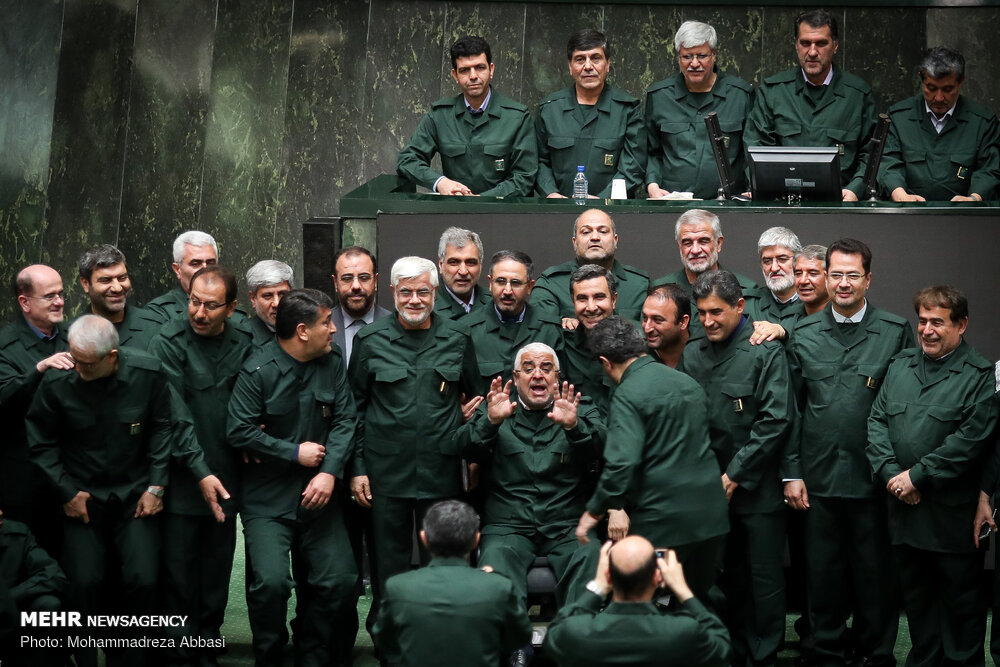
During Ali Khamenei’s tenure as Supreme Leader, the IRGC’s authority and scope of responsibilities steadily grew—first on now President Rafsanjani’s initiative, later owing to the Supreme Leader himself, who saw the Guards as his essential power base against the reform movement after Khatami became president. Among the earliest examples was the Guards’ consolidation and expansion of the Basij militia, and then its internal deployment against Iranian citizens during the Mashhad riots of 1992 and Qazvin unrest of 1994. The IRGC’s political presence grew as well. As the share of Majles seats won by clerics dwindled from a high of 55 percent in 1984 to less than 15 percent in the early 2000s, former Guards began to enter the legislature in growing numbers—first slowly, then with a rush in 2004 when many reformist incumbents were disqualified. With greater numbers came greater influence: by 2020, former IRGC or Basij members comprised a majority of the parliament’s presidium and held at least 16 committee chairs or similarly powerful positions. The wall between Guard and government service is thin at best, and many of these legislators will return to active duty as soon as they exit the formal political scene.
Under Khamenei and Rafsanjani, the IRGC was also granted a much broader role in economic affairs. Its budget expanded significantly, and it inaugurated a vast network of subsidiary businesses, including the Khatam al-Anbiya conglomerate—which itself owns at least a half-dozen engineering subsidiaries and a controlling stake in the country’s largest shipbuilding company, among many other interests—and an array of financial and credit institutions. Through Khamenei and Rafsanjani’s support of the Guards’ economic activities, the IRGC grew into a pillar of Iran’s shadow economy.
“Costs borne by the public”
After Rafsanjani’s failed bid in 1989, there is no evidence that an Artesh-IRGC merger received serious consideration in regime circles for the next three-and-a-half decades. That changed—though for reasons much different than organizational efficiency—after January 28, 2026, when the European Union placed the IRGC on its terror list, significantly expanding a global sanctions program that targets the corps’ assets and revenue streams. Due to the IRGC’s outsized role in the shadow economy, the international pressure threatened Iran’s economic system as a whole.
Just nine days after the EU decision, Jomhouri-e Eslami newspaper—founded as the mouthpiece for the Islamic Republic Party, Iran’s sole ruling party under Khomeini, and whose views generally echo those of the regime’s conservative clerical core—published a front-page editorial championing “cohesion” and “unity, efficiency, and strength in the country’s defense structure.” Merging the IRGC and the Artesh was the only solution to save Iran’s economy, according to the editorial—an argument with special significance given that Ali Khamenei had been the paper’s license holder since its founding in 1979, according to the current managing editor.
Explicitly invoking Rafsanjani’s decades-old effort to merge the Guards and Artesh and Khomeini’s lack of objection to the idea, the newspaper blamed a systemic “misalignment of institutional roles“ for a “significant part of our problems today, from the economy to foreign policy.” It described the IRGC as entering “fields for which it was neither designed, nor equipped to handle the consequences,” and in response advocated “a rational consolidation of power and the return of each institution to its defined legal mandate.”
“Such a return to the logic of law and institutional division of labor could both facilitate the containment of a formidable enemy and reduce the accumulated costs borne by the public,” the editorial stated.
Jomhouri-e Eslami’s advocacy of an Artesh-IRGC merger might have served as a prelude to consequential deliberation over the prospect in policy-making circles. Then the war changed almost everything.
An unchallenged protagonist
The United States and Israel attacked Iran on February 28, 2026. Regardless of their stated objectives, the ensuing war has so far had one unmistakable effect on the power dynamics within the Islamic Republic. The IRGC, which had been sanctioned by the EU as a terrorist organization for the first time a month before the war and whose economic activities and institutional autonomy were being called into question by a regime mouthpiece very close to the Supreme Leader, has now become the main actor on the Iranian stage.
“Current political and military conditions suggest that everything is effectively in the hands of the IRGC. The Guards appear to be making the key decisions,” the University of Tehran economist, who spoke on condition of anonymity due to safety concerns, told Resanegar. “The most likely scenario is that the Islamic Republic will remain, with the difference that the IRGC’s presence in the economy will be strengthened as a result of the two recent wars.”
After Trump withdrew from the JCPOA in 2018, there was still popular sentiment in favor of curtailing the Guards’ power. They were able to deflect it with significant support from Ali Khamenei, who never made a single public statement about the divestiture directive announced in his name. While the Guards’ institutional position was strengthened, the Supreme Leader retained ultimate authority, with “both oversight of the decision-making process and the ability to control and contain the IRGC,” a veteran security analyst, political scientist, and former University of Tehran faculty member told Resanegar.
Khamenei’s assassination meant the elimination of that oversight, said the analyst, as the succession of his son, Mojtaba Khamenei, to the post of Supreme Leader was entirely orchestrated by the IRGC. “The succession crisis in the Islamic Republic could not have been resolved so easily without IRGC involvement,” explained the security analyst, who also spoke on condition of anonymity. “It can therefore be said that, in the new configuration of the Islamic Republic, the IRGC has gained a far more important, prominent, and influential role.”
In the absence of any restraint Ali Khamenei might have imposed, the war also freed the corps to flex its muscle in the Strait of Hormuz. While the US blockade has temporarily thwarted the IRGC’s profitable protection racket in the strait, Majles representatives closely aligned with the Guards have introduced a bill under a fast-track, “triple-urgency” mechanism that envisions permanent transit tolls and a new legal framework for the waterway that would make the IRGC the strait’s de facto gatekeeper, dramatically expanding both its revenues and geopolitical influence. “Who would actually collect those fees?” the economist asked rhetorically. “Customs authorities? No—everything would have to be coordinated through the IRGC.”
The conflict has reinforced the Guards’ primacy in foreign policy more broadly. When President Masoud Pezeshkian attempted to reassure Arab neighbors early in the war, military officials swiftly overrode his message with threats of regional escalation. The incident highlighted how, in the new order brought on by the conflict, the IRGC has become the ultimate arbiter of Iran’s external messaging, relegating civilian leaders to a largely symbolic role.
“On the third day of the war, President Pezeshkian apologized to the Gulf states. Five minutes later, Khatam al-Anbiya issued a statement effectively retracting his remarks,” the economist said. “This means that the decision-maker is none other than the Islamic Revolutionary Guard Corps.”
He described one of the war’s first major consequences as the normalization of the Guards’ economic role. “If yesterday the IRGC was the emperor of Iran’s hidden economy, today it is becoming the central authority within the formal and visible economy,” he said, foreseeing “that no major protocol or policy will be written from this point forward without the IRGC playing a role. Everything will require its approval and coordination.”
Many hopeful observers expected the 2026 war to debilitate the Islamic Republic or even precipitate its collapse. Instead, the conflict appears to have facilitated a large-scale transfer of power from the Supreme Leader’s office and broader clerical establishment to the security apparatus. If the current trajectory continues, the war may be remembered as the event that, far from bringing down the Islamic Republic, consolidated the IRGC’s dominance over it.