
The country has no dearth of laws against financial wrongdoing. But it repeatedly fails to enforce them, while precious savings disappear.
By summer it was quiet most every hour of the day in the Tehran gold bazaar. War and recession had extinguished much of the market’s customary bustle. Then one morning, in late July, the hush in one of its passageways was broken by shouting.
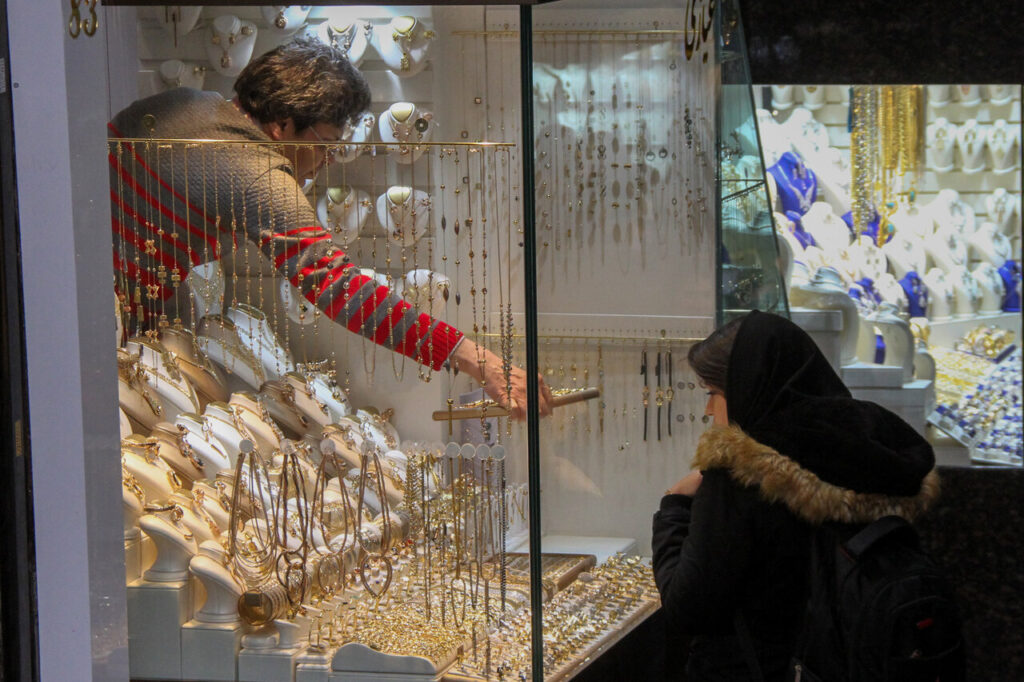
A group of customers had gathered outside a gold shop. For months, they had been handing over their modest savings to the dealer, a little at a time, under an arrangement increasingly promoted on Iranian social media: you did not need enough money to buy a bracelet, a necklace, or even a tiny gram bar of gold outright. You could deposit whatever you had, and your petty tomans would, as if alchemically, accumulate as gold. Eventually, when you had saved enough, you could take home the real thing.
Now the shop’s shutters were down. There was space enough between them to see that the establishment had been emptied out. The cries for the proprietor to show himself were angry and hopeless.
“They fell for these social-media ads offering advance purchases of gold with any amount of money,” a Tehran gold-market source told Resanegar, Tehran Bureau’s economic unit. “And now they have nowhere to turn.”
No official account of the case had yet been made public. The market source estimated that the dealer had taken in deposits amounting to the value of four or five kilograms of gold (well over half a million dollars at current prices) and that perhaps 70 or 80 people had come to the bazaar after learning of his disappearance. The full number of victims remains unknown.
In Iran, variations of this story play out with remarkable regularity. A business collects people’s savings, over time, while openly advertising the arrangement. The official apparatus to monitor and verify the legitimacy of such transactions exists, but yet, in case after case, the state steps in only—if it all—after the money has vanished.
The appeal of the gold schemes is easy to understand. For many Iranian families, years of high inflation have turned gold into a refuge for savings whose value would otherwise invariably drain away. The advertisements exploit the anxiety directly.
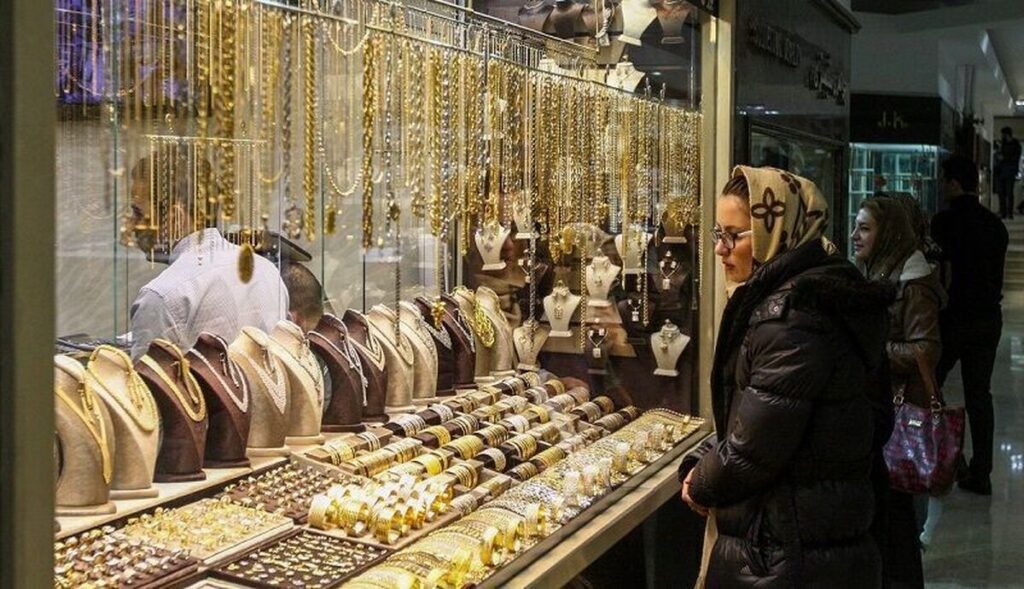
“The biggest mistake when buying gold is waiting until you have all the money,” one gold dealer says in a social-media promotion for a similar arrangement. Bring whatever you have, the ad promises. Invest it. When your accumulated savings equal the price of the gold you want, choose it from the display. There is no need, the dealer boasts, to pay tax or a manufacturing fee. Any amount will do.
Different commodities have featured in similar pitches—and scams. In the first weeks of 2024, Kourosh Company, formally Kourosh Pardazan Aysa, became one of the most notorious examples. The company offered iPhones for about 20 million tomans (approximately $350 USD at the time), roughly half their prevailing market price, claiming that it could do so by eliminating middlemen. It advertised heavily, retaining celebrities to participate in its promotional efforts. Thousands of customers reportedly paid in advance. Then, in February 2024, the company’s chief executive fled Iran, and the business collapsed amid enormous unpaid obligations and crowds of customers trying to recover their money.
Before Kourosh, there were financial and credit institutions such as Caspian and Samen al-Hojaj, which attracted deposits by promising unusually high returns and then imploded, due in part to giant loans made to regime insiders that were never repaid. Modest depositors numbering in the tens of thousands lost their entire life savings.
While the details differ from case to case, for the victims the sequence is painfully familiar: an enticing offer, an aura of legitimacy, aggressive advertising, cash—sometimes huge sums—collected in plain view of regulatory bodies, and then the vanishing act.
Iran now has a word dependably associated with such episodes: malbakhtagan, the people who have lost their money. They appear outside government buildings and courthouses demanding repayment, sometimes through years of petitions and protests. In the political vocabulary of the Islamic Republic, they constitute both a legal problem and a potentially dangerous social constituency. Once there are enough of them, their private losses become a challenge to public order.
At sea among the “sultans”
The persistence of these scandals might suggest a simple explanation: Iran does not have the laws to stop them. Hossein Raisi, a human rights lawyer and professor whose legal practice has included business transactions, commercial law, and the oil sector in Iran, argues the opposite. “We do not have a legal vacuum,” he told Resanegar.
Iran, in fact, has accumulated a formidable architecture of anti-corruption law. There are statutes against fraud and money laundering; restrictions on taking deposits without authorization from the Central Bank; consumer-protection provisions; asset-declaration requirements for officials; transparency rules; whistleblower protections; and severe criminal penalties for certain forms of economic disruption.
The country has also created special courts for economic crimes. To Raisi, their very existence is less evidence of a functioning anti-corruption system than of the depth of the underlying disorder.
“When every day someone is called the ‘Sultan of Coins,’ the ‘Sultan of Dollars,’ the ‘Sultan of Cars,’ and people are executed while corruption does not decline,” he said, “it means these measures are not effective.”
The Islamic Republic has long been fond of personalizing systemic failures. Periodically, a sensational corruption case produces a spectacular villain. The culprit is assigned a title grand enough to match the offense—some new “sultan” of a distorted market—and the state presents his punishment as proof that the system is policing itself.
But removing a corrupt actor does little to eliminate the conditions that made his rise possible. It is much easier to imprison an individual beneficiary of a distorted market than to interrogate how the market was distorted, how he gained access to it, who protected him, who failed to monitor him, and why opportunities of the same kind keep recurring.
Iran’s problem, as Raisi sees it, is rooted not in the absence of official prohibitions, but in a political economy in which great swathes of money move through establishments and relationships that are rarely more than semi-transparent, and where access to power always matters more than formal rules.
Sanctions have deepened the problem. Oil revenue and other state funds often convey through intermediaries, ostensibly private companies, informal channels, and networks whose opacity is in part a consequence of Iran’s isolation from the international financial system and in part entirely calculated. The less transparent the movement of money, the easier it is for political access and private enrichment to become entangled.
At the same time, Iran hosts massively wealthy institutions that occupy an ambiguous space between public and private power. Raisi cited Astan Quds Razavi, the vast religious and economic conglomerate centered on the shrine of Imam Reza in Mashhad, as an example of the parallel structures that complicate ordinary mechanisms of accountability.
“There is no serious will to confront corruption among those close to or dependent on power,” he said. “There is no will to make these wealthy parallel institutions transparent and subject to law.”
A former member of parliament who spoke to Resanegar describes one potential step to address the institutional mire as the enactment of a law Iran still does not have: a comprehensive conflict-of-interest statute.
A conflict-of-interest bill has circulated for years among presidential administrations and parliamentary committees without advancing. Its provisions would nominally disentangle the intricate fabric of patronage: regulators with private financial interests, officials appointing relatives, people simultaneously occupying public and private positions, and interested parties exerting influence over government decisions.
“One of the most important laws for fighting corruption still has not been passed,” the former MP said, “because there is no will in the establishment or in parliament to pass it.”
The reason, in his telling, is hardly mysterious. “They themselves have interests,” he said of legislators and the networks around them. “The law would restrict them.” Or would it?
Raisi doubts that another statute, however carefully written, would actually alter much without a major shift in the Islamic Republic’s approach to governance. A conflict-of-interest law assumes the existence of institutions capable of enforcing it impartially. In a judiciary wide open to political influence, even a perfectly worded law can become merely another instrument of corruption, wielded against those out of favor, ignored for the insiders’ deals.
“Such a law can matter when you have an independent judiciary,” Raisi said. “When people connected with the judiciary, including Akbar Tabari, or Ayatollah Sedighi, can spend years using their positions to fix deals or engage in land-grabbing without being held accountable, a conflict-of-interest law is not enough. Relationships within the centers of power are so intertwined that they prevent enforcement.”
The void behind the statutory curtain
Every state is home to corrupt actors and every market is vulnerable to fraud. The crucial distinction between systems that function and those that fail is what happens when wrongdoing encounters the people in a position to reveal it—whistleblowers, journalists—and the institutions equipped to stop it: regulatory agencies, prosecutors’ offices, the courts.
In early 2021, the country made permanent its Law on Promoting Administrative Integrity and Combating Corruption, which requires public bodies to increase transparency around regulations, licenses, contracts, procedures, and information affecting citizens. In late 2023, it adopted a law intended to protect people who report corruption, including provisions for confidentiality and legal protection. A broad freedom-of-information law followed in 2024, covering the executive, parliament, the judiciary, municipalities, state broadcasting, state-owned companies, universities, and other public institutions.
Iran also has an anti-money-laundering law. It has legislation requiring senior officials to declare their assets and those of their spouses and dependent children. On paper, it all looks impressive. In reality, the legal architecture is little more than a façade, at best.
Take the case of Yashar Soltani, an investigative journalist who in 2019 published documents connected to the so-called “astronomical properties” scandal, involving the improper transfer of valuable Tehran municipal real estate during Mohammad Bagher Ghalibaf‘s tenure as mayor.
Far from turning Soltani into a hero of Iran’s vaunted anti-corruption regime, his exposé made him a target of the state. He was prosecuted and sentenced to five years in prison on charges including collecting and publishing classified information, publishing falsehoods, and defamation. Pardoned after ten months, he was arrested again in June 2024 and incarcerated for another four months. Neither Ghalibaf nor any of his associates were ever charged as a result of the scandal.
Were the whistleblower law actually enforced, said the former MP, “many of these instances of corruption might never have occurred. But not only is the law not enforced, people who expose corruption continue to be threatened.”
He observed, as well, that “once the identities of these corruption whistleblowers become known, their access to information is restricted and efforts are made to prevent information from reaching them.” Like the whistleblower law, the freedom-of-information law is on the books that few in authority care to reference.
“In such an environment,” the former MP said, “fighting corruption is little more than a slogan.”
There is another reason that cases of collective fraud are proliferating. The former MP described a government so consumed by political instability and daily economic crisis that ordinary governance itself has begun to weaken. Even among relatively diligent regulatory officials, supervision slips as concern about one’s own future rises.
“Many people now see self-protection, accumulating wealth, and transferring it abroad as their priority,” he says. “They are trying to save themselves.”
In such a climate, swindlers’ success is less reliant on systemic corruption and specific collaboration. Institutional exhaustion is a fine facilitator. A regulator that is corrupt and a regulator that is absent may produce the same result for the person standing outside a shuttered gold shop.
This leaves the Iranian state to play its peculiar role in the recurring dramas of the malbakhtagan. The feigned monitor and occasional co-conspirator also steps in from time to time as redeemer.
The government often gets involved only after a scheme has collapsed and the number of victims has become politically significant. The state faces a new calculation: whether anger over the losses could metastasize into something graver. Government funds can then become the instrument for containing a crisis that purported government oversight wasn’t there to forestall.
Fleecing the weak
Raisi describes this as still another destructive feature of the familiar cycle. When the state compensates victims, it may relieve immediate suffering—along with its primary purpose of defusing protest. But it also transfers the cost of weak regulation from the people who benefited from the scheme to a society at large already under severe economic strain.
The proper approach, he argues, is to require businesses taking money in advance to provide guarantees before they are allowed to collect it: segregated funds, proof of financial capacity, insurance or other mechanisms capable of protecting customers if the business fails.
The principle would seem obvious. Before allowing someone to take ordinary citizens’ money, make sure the money can be paid back. Instead, Iran repeatedly does the reverse, permitting the collection of funds without anything close to effective oversight.
The stakes grow larger as new forms of fractional investment appear. Tehran Municipality has recently begun promoting the sale of tiny shares in residential projects, a scheme described in the Iranian press as a kind of “meter-by-meter” or even smaller-scale path into housing for people who cannot afford an apartment.
Such projects are not inherently fraudulent, and they should not presumptively be conflated with a gold dealer plotting to disappear with his customers’ deposits. Advance sales, pooling small investments, and fractional ownership can all be legitimate. But their legitimacy ultimately depends on there being answers to a set of questions whose crucial nature Iran’s recent business history should make clear.
How, precisely, is the buyers’ ownership recorded and registered? Where are their deposits secured? Who monitors construction? Can developers use the funds for something else? What happens if the project stops halfway through? Who stands behind the obligation? What recourse does an investor have?
To the guileless or foolhardy, these questions can seem tediously technical until the day the shutters come down. Beyond that point, it’s often too late for the answers to make a difference. And in the case of the “meter-by-meter” scheme, those answers have yet to appear.
Even the most effective government cannot prevent every financial deception or catch every con artist in the act. But when businesses openly collect “prepayments” in giant sums while regulators do nothing; when warning signs prompt no intervention; when journalists who uncover corruption face greater risks than those they expose; and when the public treasury is habitually bled to redeem private losses, the deprivation of governance is blatant.
Iran suffers no shortage of laws, but rather the will and fitness to constrain the exploitation of financial and social precarity. Such a country can continually inveigh against corruption, legislate against it, while entirely failing to check it. That requires consistent application of the rule of law, application totally lacking in today’s Iran.
Since the founding of the Islamic Republic, the state’s anti-corruption apparatus has become increasingly elaborate even as corruption turns ever more pervasive and its victims multiply. Each new scandal, each mass swindle generates investigations, pronouncements, maybe arrests, perhaps compensation, sometimes yet another statute. The gears of justice start up, briefly grind, then return to their deliberate, quiescent state, while the culture of the confidence game flourishes and the dealers feast. It’s boom time for the rackets.