
In 21st-century Iran, yesterday’s “oppressed” are increasingly recast as today’s expendables.
January’s uprising that saw mass protests across Iran was sparked by people from little-known cities, from neighborhoods with power outages, water scarcity, and overcrowded housing. In the old 1979 revolutionary playbook, they would have been “the oppressed” (mostazafan), the underprivileged masses the clerical regime promised to elevate from poverty and social marginalization. In recent years, as the economy crumbled and destitute Iranians grew increasingly angry at the government for their economic woes, the regime began referring to them as arazel obash.
Translatable—loosely—as “thuggish rabble,” arazel obash is a term state-aligned media frequently use to describe citizens detained for crimes ranging from drug and alcohol consumption to insurgency. Originally used as a pejorative for alleged perpetrators from poorer areas, arazel obash is now being used to justify the extrajudicial arrest of any dissident, including those from upper-class backgrounds.
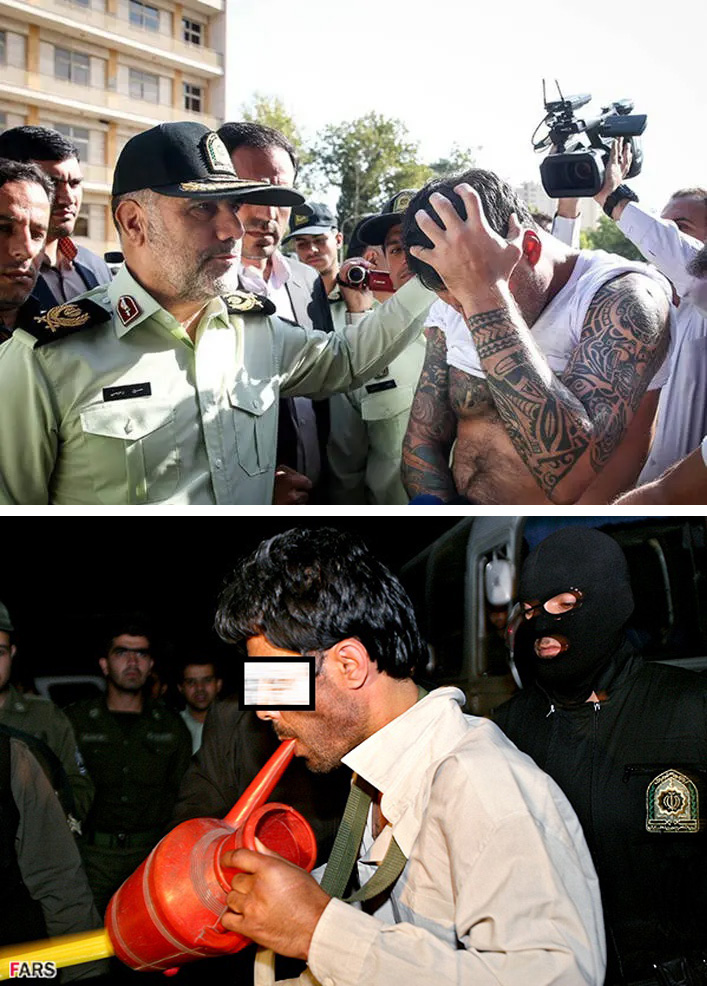
Recent media reports show a consistent pattern of officials applying the label to protesters and those accused of unrest-related activity in the January massacres. On January 23, Jahan News reported the arrest of 16 “arazel obash” in connection with “terrorist incidents” in Tehran, alleging involvement in arson attacks on vehicles and assaults on law enforcement. Similar framing appeared across multiple outlets: Mehr News on February 18 described the arrest of 34 “rioters, [arazel] obash and street terrorists,” while Khabaronline reported on February 6 that a mixed group of detainees—including “arazel obash,” alleged members of the MKO cult, monarchists, and others—were arrested in East Azerbaijan province. On February 26, Fars News similarly referred to individuals accused of throwing Molotov cocktails during protests as “arazel obash.”
This language is reinforced by a broader state narrative that recasts protests as organized terrorism. An IRIB report on January 25 described detainees in Semnan as “terrorist agents” seeking to turn Iran into Syria, while Mehr News three days later video labeled protest activity “street terrorism.” Officials have echoed this framing: On February 18, the IRGC intelligence chief characterized the January protests as the largest terrorist operation against the Islamic Republic since 1979, alleging coordination between foreign-backed groups, social media networks, and domestic “arazel obash,” whom he compared to organized crime enforcers from the 1953 coup era.
Commentary in pro-government outlets has amplified this line. In a January 31 article for the state-affiliated Iran Diplomacy website, Seyyed Hojjat Seyyed Esmaili, a former MKO member who is now prominent in the security apparatus, asserted that “arazel obash terrorists” were being used as proxies by the United States and Israel following their “defeat in the recent 12-day military conflict” (of June 2025). Less than two weeks later, a February 13 ANA News column claimed that “terrorists and mercenaries” had hijacked popular protests.
At the same time, the arazel obash label has been leveraged in well entrenched policing strategies. A June 8, 2024, report by Donyay-e Eqtesad noted proposals to use ankle monitors to track arazel obash, while police reported a 120 percent increase in firearm use against them last January. Under the rubric of “Tarh-e Eqtedar” (Operation Authority), launched in March 2023, security forces have carried out mass raids across Tehran neighborhoods—dozens of locations at a time—detaining hundreds of individuals. While arazel obash were the declared target of the operation, Tarh-e Eqtedar has aimed to neutralize protesters from a wide range of backgrounds. Raids have taken place not only in poor and working-class areas such as Nazi-Abad, Nezamabad, Yaftabad, and Fallah, but also middle-class neighborhoods like Tehranpars.
Inventing and expanding the arazel obash
Unpacking the arazel obash trope is key to understanding the trajectory of civil unrest in Iran and the official response to it. In the gruesome massacres perpetrated by the regime a month before the current international conflict, “thugs” appeared on both sides of the barricade: They were the drug dealers administering backstreet pain relief to wounded protesters, as well as the head-cracking thugs dealing the fatal blows. Tracking the official use of the term arazel obash helps show how the Islamic government’s policies squeezed the life out of the urban poor, whose downtrodden image was once used to rally support for revolutionary ideology.
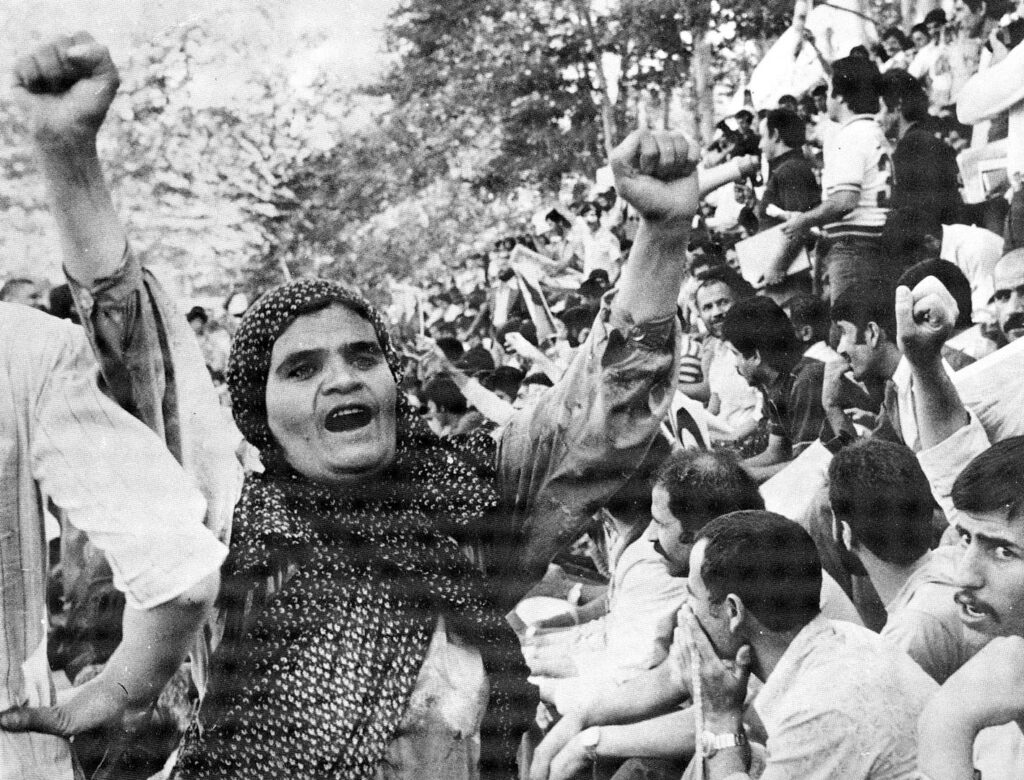
The correlation between the regime’s use of “arazel obash” and the diminishing status of working-class men in post-revolutionary Iran was observed by scholar Shahram Khosravi, who in a 2017 paper examined the “shift in the symbolic position of working-class men” in the Islamic Republic “from veneration in the first decade of the revolution to condemnation three decades later.”
Khosravi described the regime’s rhetorical shift from its early claims that it was establishing the “rule of the mostazafan“ to the use of arazel obash in describing the working-class poor. In the years following the 1988 end of the Iran-Iraq War, the regime’s economic interests became increasingly aligned with the middle and, particularly, upper classes.
Early official usage framed arazel obash narrowly as violent street offenders. A January 15, 2000, directive by judiciary chief Seyyed Mahmoud Hashemi Shahroudi demanded “violent and swift action against arazel obash” by the courts, instructing them to refrain “from any leniency or delay in sentence enforcement” toward such “violent and hooligan elements,” who disturbed public order through alcohol consumption, knife attacks, and street fights.
Reporting throughout the 2000s reflects this framing, with arazel obash commonly associated with drug dealing, mugging, and public disorder.
It is no accident that the term arazel obash gained traction during the Ahmadinejad era. Faced with a crisis of legitimacy following the disputed 2009 presidential election, the regime attempted to deflect the ire of the Green Movement, whose supporters were mostly middle and upper class, by casting itself as a protector of property owners’ interests against crime and disorder.
The regime found useful scapegoats among poor urban men, labeling them in propaganda as thieves, extortionists, drug dealers, and rapists. In a society increasingly driven by profit and neoliberalism, working-class men were now seen as failures and a burden, according to Khosravi. While their economic deprivation once dovetailed with the image of a downtrodden, self-sacrificing hero of the 1979 revolution, poor working-class men now exist outside a system that venerates consumerist entrepreneurs and thus pose a risk that warrants repression. “The masculine ‘other’ is not only poor,” Khosravi wrote. “He is often an immigrant from the provinces, belongs to an ethnic minority, and is regarded as uncultured.”
The effect of the working class’s marginalization is amplified by an economy in which millions of Iranians have fallen into poverty in recent years, Khosravi added. “The policing and punishment of the urban poor has escalated in tandem with increasing economic precarity among Iranians, particularly young people,” he wrote. “Every year more Iranians are classified as poor.”
In the years immediately preceding the 2026 uprising, law enforcement intensified surveillance and arrests under the arazel obash label. Last October, Borna News quoted Baharestan’s municipal police chief reporting a 140 percent increase in arazel obash detentions thanks to constant monitoring and preemptive arrests, while an official in the city of Quds cited a 19 percent rise days later.
Following the January 2026 protests, the term reached its most expansive—and politicized—usage, with state media and security agencies routinely casting detained protesters and dissidents as arazel obash. Across the past two-and-a-half decades, the term has shifted from a descriptor of street-level criminality to a flexible category encompassing both informal, violent enforcers of the interests of the state and, crucially, almost any of its political opponents.
Hooligan history
The nebulous use of arazel obash has allowed the regime to apply it to anyone it finds threatening or expendable. However, the vivid descriptions of tattooed, machete-wielding legbreakers that regularly appear in government statements allude to a figure from a widely recognizable underclass.
At its core, the arazel obash is an updated, vilified version of a gangster-like persona with deep roots in Iranian culture. Dating back to the looti wrestling culture of the Qajar era, a subculture of men who lived outside the law was closely tied to pahlavani traditions associated with the traditional zoorkhaneh (house of strength) gymnasium, and was often rooted in the “south of the city” (jonoob-e shahr)—the working-class areas of south Tehran. During the Constitutional Revolution and into the reign of Reza Shah, this subculture was also associated with the javanmard—a figure defined by chivalry, loyalty, and the protection of the weak, though this ideal often coexisted with more ambiguous or coercive forms of local power.
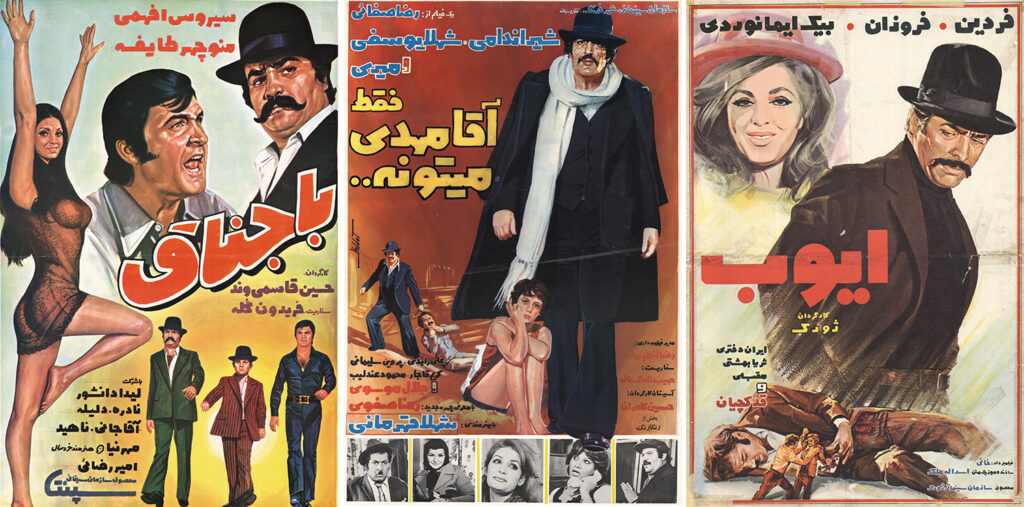
With the expansion of centralized law enforcement and a modern judicial system in the 20th century, this social group—whose authority had partly depended on informal systems of protection and physical force—became increasingly marginalized. The pahlavani culture was succeeded, in part, by the lati1 and jaheli2 subcultures. Participants in these subcultures sometimes acted as freelance extortionists (demanding money from people and businesses in exchange for protection), sometimes operated in concert with criminal groups, sometimes supported clerical networks against the state, and sometimes aligned with the state against its opponents. Their identity became tied less to a fixed moral code and more to shifting loyalties and patronage. Still, the machismo and “Godfather-style” code of honor associated with lats and jahels inspired a 1970s genre of Iranian popular cinema (filmfarsi) in which they were portrayed as morally complex antiheroes or “champions of the people.”
The lats’ relationship with the state has often been ambivalent. Their role in neighborhood control largely disappeared with the organization of formal security forces in the 20th century, while the 1979 revolution dismantled whole swaths of the urban economy—such as nightlife and various informal markets—on which many depended. Their lifestyles were further crushed by the economic policies of the Islamic Republic, which flip-flopped on key policies around land redistribution and infrastructure support in the poor neighborhoods where they lived.
Meanwhile, elements of this subculture were periodically co-opted by power structures, whether by clerical networks, local authorities, or security forces. Their position has thus oscillated between marginalization and instrumentalization, depending on the needs of the state.
Both sides of the barricade
Even as the regime tracks down dissidents under the guise of protecting the public against arazel obash, it enlists members of the same underclass to do its dirty work. During the massacres, social media users widely circulated the image of a young man with neck tattoos at a Sharif University protest in Tehran. He appears to have a metal rod tucked under his arm and is playing the senj (hand cymbals) to stir up the Basij as they prepare to confront demonstrating students. The photograph gained attention precisely because the man’s presence among the paramilitary force is an eyesore. Regime-aligned fundamentalist groups like the Basij view tattoos as unholy, suggesting the young man is hired muscle rather than a card-carrying militia member.
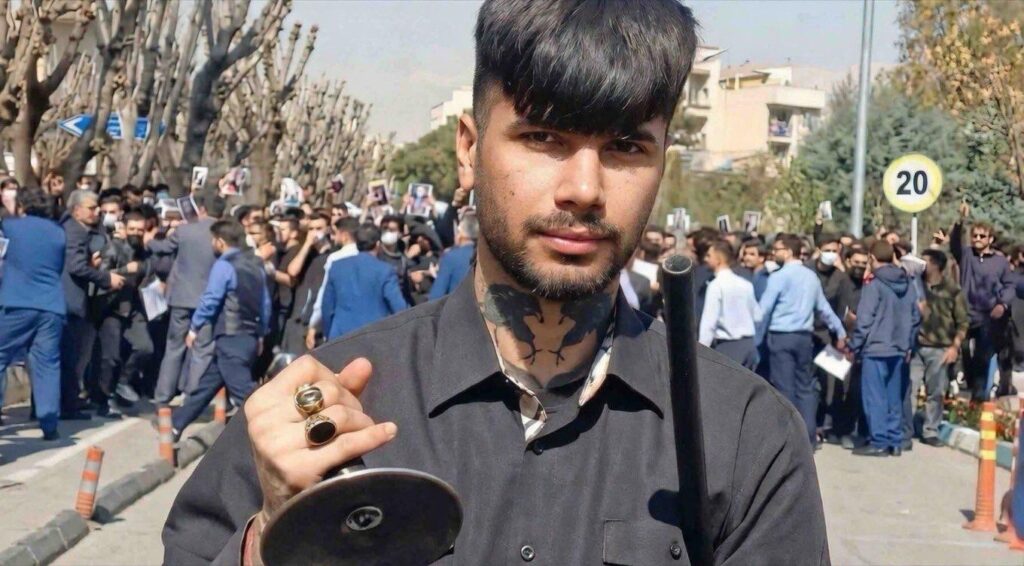
The co-optation of members of the urban lower socioeconomic classes into the security apparatus is a practice dating back to the foundations of the Islamic Republic. In this period, many young men who a couple decades later would be labeled arazel obash were recruited into the early “revolutionary committees” and eventually merged into the police force. Many others joined the IRGC and other state security organizations.
In the aftermath of the 2009 Green Movement, IRGC figures acknowledged recruiting individuals labeled as arazel obash into the Basij to suppress protests. In a 2016 interview cited by Ensaf News, Quds Force commander Hossein Hamadani described identifying and monitoring thousands of such individuals and later incorporating them into operational units, arguing that those “accustomed to knives and machetes” were effective in confronting demonstrators.
There were also efforts by other arms of the regime to absorb or redirect this population: Jahan News reported on June 25, 2011, that cleric Mohammad Reza Shams-Abadi was recruiting arazel obash in Qom through state-supported religious programs, including subsidized trips intended to attract and retain them.
By the mid-2010s, the label had also been operationalized in municipal governance. A June 18, 2016, report by ISNA indicated that Tehran municipality units were recruiting arazel obash into enforcement bodies such as the Obstruction Removal Unit (Shahrban) to clear street vendors—and sometimes to act as muscle for broader, extralegal crackdowns.
At the same time, public understanding of the term appeared increasingly shaky. Field reporting by Ensaf News on June 2, 2020, found that residents in Tehran neighborhoods such as Abdolabad and Shademan could not clearly define arazel obash, with many questioning whether such a group meaningfully existed.
As the middle classes spiral into poverty after years of economic mismanagement, a descent only hastened by the current conflict, entire social strata are at risk of being recast as arazel obash—and thus becoming that much more vulnerable to the regime’s war on its own people.
Writing in 2017, Khosravi cited police statistics suggesting that 95 percent of all arrested arazel obash are younger than 25 and many are from south Tehran, yet “it is not clear on what specific charges these men are being arrested.”
“In the absence of a clear legal definition,” Khosravi warned, “anyone can be arazel obash.”
- Originally, lati (which derives from the wrestling-related looti) was mostly positive in connotation: men associated with physical strength, local influence, and a code of honor (helping the weak, loyalty, masculinity). Especially in urban settings, lati eventually came to refer to a street tough or enforcer, but one who might still claim a moral code. In filmfarsi, the lat is often the antihero—contentious, rough, but ultimately principled.
- Jaheli comes from jahil (ignorant) and has a more consistently negative connotation. It refers to a crude, aggressive street tough, often associated with performative masculinity—flashy clothes, intimidating swagger, physical violence. While a jahel might still gesture toward “honor,” the emphasis is more on bravado and domination.