
Tehran is big, it’s diverse, like the sea.
Tehran is like a sea—you can’t see where it begins or ends. Every part of it has its own fabric, its own culture, and its own social class living in it. That’s what makes it unique. Like, if you go down south, for example, Yaakhchi Abad is a working-class neighborhood, but right next to it, Naziabad is home to pink-collar and administrative types. Or if you go to Javadiyeh, that’s working-class too—same with Rah Ahan, the railway neighborhood.
As you move up to Saadatabad, you find people who’ve come from different areas—like a lot of folks from Naziabad who made it and moved up in life. They’re managers, teachers, civil servant types. It’s kind of an upper-middle-class neighborhood. But in places like Farmanieh, you’ve got bazaaris and regime officials living there. Of course, some of them live in Saadatabad too because Evin Prison is where many guards and security forces are stationed.
So, yeah, Tehran has all kinds of layers—social layers, governmental layers. Every part of it is different. Like, if you go toward Islamshahr and those areas, that’s a whole different fabric— more working-class, more on the margins, both culturally and economically. So that’s how you have to picture Tehran: like a sea made up of all kinds of intertwined social, cultural, and economic layers.
Tehran’s vastness is beautiful—that’s the thing, it’s big, it’s diverse, like the sea. You don’t feel confined; it doesn’t give you that small-town feeling. In smaller cities, you walk around a bit, and that’s it—this street, that street, you’ve seen it all. But not Tehran.
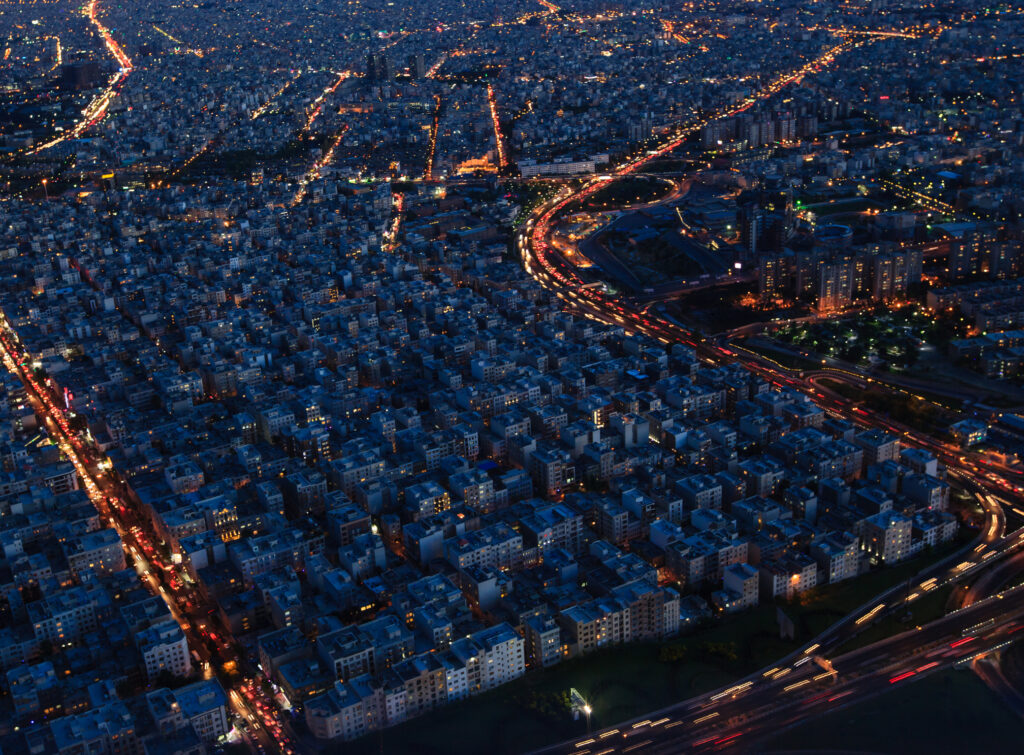
With the exception of the Women, Life, Freedom movement and Kurdistan, it takes about eight years for whatever happens in Tehran to repeat itself elsewhere. Tehran has always been ahead of other towns—its growth, its awareness, its social evolution—it’s just different.
They say a fish becomes a whale in the sea; Tehran is that sea—those who live in it grow through its complexities, break, rise again, and rebuild themselves. Tehran is unforgettable—even for those who visit only once.
But the traffic is terrible, the air [pollution] is terrible, its apparatus of repression is terrible. In other cities, repression might not be as severe, but in Tehran it’s systematic. Poverty—you can find that anywhere, just in different forms: one way in Sistan and Baluchestan, another in Tehran.
It’s like a dying animal thrashing about, like a headless chicken flailing up and down. The system simply doesn’t work anymore.
I was born in Tehran and grew up there. My parents are from Zanjan—they were Zanjani, they were Turks. I remember my father had a taxi when I was about three or four. On weekends, he would take the whole family in his taxi from the southernmost corner of Tehran, Naziabad, where we lived, toward the mountains in north Tehran, where the Shah lived in Sa’dabad.
The Shah’s huge palace—with its armed guards and manicured lawns, curbs, and tidy landscaping—felt like another world compared to our own neighborhood, where the streets were still unpaved, without curbs, grass, or even trees, just a cluster of apartment blocks where my father had managed to get us a place. Below our neighborhood were two brick kilns, overrun by stray dogs.
Even though we lived there and played outside every day, it never felt safe. We always had to fear kidnappers. I vividly remember my mother telling me, “If someone says, ‘Come here, your father’s here,’ or, ‘Your brother or sister’s here,’ don’t believe them—those are kidnappers. You run away!”
One weekend, we were in the car with my brothers and sisters. As we got close to Sa’dabad Palace, I suddenly had the urge to stick my head out the window and shout, “The Shah is an ass!” I asked my mother if I should do it. I couldn’t have been more than five. It was as if she’d been struck by lightning. “Don’t you dare!” she said. “They’ll come arrest us and take us all away!” She was terrified, and I could tell from her reaction that it was serious. That moment is one of my strongest memories.
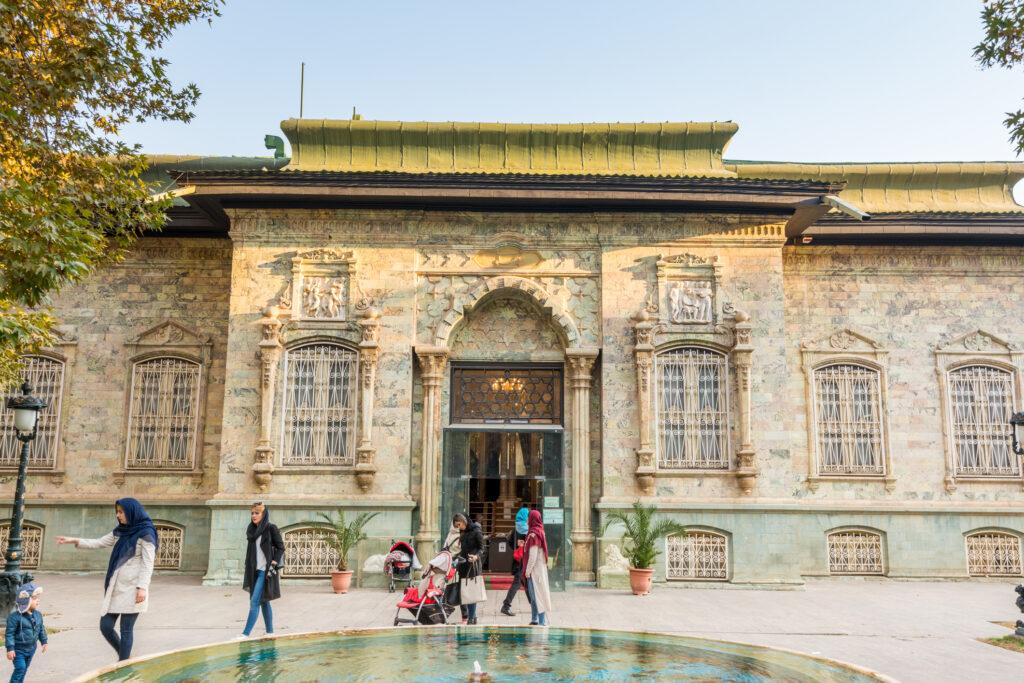
When the revolution happened, I was eleven years old. When the regime collapsed, that became one of my happy memories. In the way a child feels things, I was overjoyed. Maybe some people won’t like to hear this, but one of my happiest memories was simply that—as a child—it felt like everything had changed.
People were standing guard in their own neighborhoods. Even as a kid, I could sense that things had changed. It’s a strange feeling to see everything turned upside down—people controlling the streets, people armed, everyone with weapons in their homes. For a child my age, it was bewildering.
But after the revolution, we never felt happiness again. There was no more joy. There was repression, killings, arrests, executions, massacres in the prisons. They killed so many people in the 1980s. There were Hezbollahis, thugs with clubs… After that, I never felt anything good again. It was all [fear and] stress.
I had some political affiliations and wanted to leave the country for a bit when I fell into their trap. That day, I left the house early in the morning and sensed I was being followed. I was only twenty-one at the time. I tried taking counter-surveillance measures. They were on motorcycles, in cars—whole teams of people [after me]. The scope of it was beyond anything I could have imagined.
I went to the airport. At one point, I sat down to tie my shoe and noticed a bearded man with glasses looking around. The moment he saw me, he quickly turned his face away. They arrested me at the airport. Later, during my interrogation, I saw the same man again—he was one of my interrogators. I recognized him from under the blindfold.
After that, well, you’re interrogated—there’s torture, and they mess you up. I was already on radar—when I saw my interrogator at the airport, that confirmed it for me. I was planning to go and come back, but they arrested me. Towhid Detention Center—that’s my worst memory. I experienced things there: those torture chambers, those interrogations…
I was one of the people who started the Association of Free Journalists in Tehran; it was supposed to be an independent organization. We took advantage of the turmoil between the Participation Party and the Workers’ House—when the waters were muddy—to make it happen.
A few of us journalists in Tehran said, “Let’s form a professional association that’s independent—something nonpartisan, not tied to any faction.” At that time, the Ministry of Labor was controlled by the Workers’ House, and the Association of Iranian Journalists was in the hands of the Participation Party.
We drafted our proposal and sent it to the Ministry of Labor. It took about six months to get the permit. Meanwhile, the Association of Iranian Journalists started sending letters and making threats—filing complaints against the founders of the new association and reporting them to the Revolution Court.
Then the press division of the Supreme Leader’s intelligence office got involved. There was a cleric named Haeri—his wife was the public relations officer at Entekhab newspaper. He had a plan to take over our association: first, infiltration; then seizing control of the secretariat; and finally, replacing the board of directors.
After a while, we started noticing a lot of people from right-wing media joining the association. We thought that’s fine—we are a professional organization, after all. Then someone suggested that since membership had quadrupled, we should hold an extraordinary assembly. We agreed.
But when the results came in, almost all the founding members had been voted out. We were suspicious, but we said fine—the ballot box decides who gets elected, and we accepted the results.
A few days later, Haeri held a meeting at Laleh Hotel. He invited everyone except two of the founding members who had been reelected in the extraordinary assembly. During that meeting, he got into an argument with one of the inspectors, who immediately called the others to tell them what was happening.
Right away, all the elected members gathered for an emergency meeting. The majority of those who had gone to the Laleh Hotel meeting were Haeri’s plants inside the Association of Free Journalists. They later claimed that the purpose of that meeting had simply been professional training!
During the meeting, one of the founding members noticed a small red light blinking inside the bag of a reporter sitting next to them and realized the session was being secretly recorded. That’s when we knew for sure someone was behind all this, pulling the strings from behind the scenes.
A fight broke out on the spot, and Haeri’s crew stormed out of the meeting, which was being held in a magazine office. The founding members immediately announced an extraordinary assembly, which Haeri’s camp and the Supreme Leader’s Intelligence Organization boycotted.
After that, we began recruiting directly from the press community. The Association of Iranian Journalists finally realized how badly they’d misjudged things. Everyone was worried our newly formed group might fall into the hands of the right wing.
In the end, we held the extraordinary assembly, and the Association of Free Journalists of Tehran remained independent. Later, Haeri called one of the inspectors and said, “You’ll end up in Evin one day—we’ll make you pay then.” We told him, “The water’s already been spilled—put it back in the cup if you can.”
The last time I was in Tehran was during Ahmadinejad’s presidency. During Ashura and Tasua that year (2009), people were out on the streets from early morning—around 10 a.m.—chanting [anti-government slogans]. They had taken over Valiasr Square; some had even climbed on top of the police kiosk. My wife and kids were with me, so I stayed in the car and didn’t get out. Then the clashes intensified—alley by alley, street by street. On Kargar-e Shomali Street, there were heavy clashes.
People on foot told those in cars, “Drive slowly and honk your horn.” The honking had become a symbol of protest. Drivers created traffic jams and expressed their dissent through continuous honking.
The IRGC motorbike units arrived, saw the traffic, and tried to make a U-turn. Two lines had formed: on Kargar-e Shomali were the people; on Kargar-e Jonubi, the Basij forces and the like, with cars lined up behind them.
Stuck in that traffic with my family, I saw the motorcyclists trying to get around—to reach the other street and put down the kids who were throwing stones. I thought, if I block them, they’ll have to move onto the sidewalk. So I drove forward and blocked their path, pretending it was just traffic. They had no choice but to go onto the sidewalk—and once they did, the protesters surrounded them and pelted them with stones. They got quite a beating there.
Then someone shouted that the road was clear, so we started moving again. That’s when I realized some of the Basijis had taken cover behind people’s cars—stones were coming at us and hitting windshields. They were using the cars as shields. But that trick didn’t work either. The drivers on the street quickly realized what was happening and cleared the road. I even ended up in a fender bender that day.
I miss Iran, but there’s nothing I can do about it. It’s hard. Our country is truly something else. You drive down those roads and see the colorful mountains, the desert sands, the lush north—it’s breathtaking. You can’t help but feel: this is our country, our history, our roots, our past. There’s so much to be proud of.
We have an ancient land—five times the size of Germany—rich in oil and gas, with four distinct seasons. You can go skiing in Urmia and, an hour later, fly south to swim in the sea. It’s a place of great food, excellent nuts and dried fruits, warm and hospitable people, and remarkable cultural diversity. The vastness of this land—its position as a bridge between Europe and Asia—has given it so much.
Socialism is very strong in Europe. But when you look deep into it, it begins with Mazdak, with the Zoroastrians—the Mazdakites who, even back then, sought social justice and equality for women and men.
When Shapour Ravasani, a professor at the University of Oldenburg in Germany, came to Tehran, we interviewed him. He specialized in social economics. He once said his colleagues had asked, “Where did the seed of leftist thought in our country come from?” and they began researching it. They traced it back to the wars between the Persians and the Greeks. Some of the Persians taken prisoner were Mazdakites, people with those same [socialist] ideals. Through them, these ideas made their way to Greece and from there gradually spread through Europe.
This is what German scholars themselves uncovered: the roots of this ideology came from Iran. These are things to take pride in. Even after centuries, even millennia, when you look back, you can still see their influence. It’s something one can truly be proud of.
Most European countries are federal—each state has its own parliament and local government—and they live well that way. In Germany, there are leftists and right-wingers, all kinds of parties. But when it comes to national interests, they stand united—as one. That kind of culture matters. I hope our country can reach that point too.
In Europe, from the far left to the far right, they know how to work together—they understand teamwork. There, if twenty-five percent of one party’s platform overlaps with another’s, they can form a government. We Iranians, on the other hand, share ninety percent of the same ideas and goals—but we can’t work together. That’s the problem.
If you look at individual sports like taekwondo and wrestling, we’re always at the top. But when it comes to team sports—like football—we suddenly fall behind. It shows that we never learned teamwork, not even as children.
In Germany, kids learn teamwork from the start: to paint their classrooms together, sell stuff at the school market together—everything they do is team-based.
The system itself encourages collective participation. That’s crucial. Germany has about eighty-five million people, and around seventy-five to eighty million belong to some kind of association. It’s fascinating—one person might belong to five different groups. These civic associations help people grow: learning to work together, to research, to propose solutions, to plan, to execute—and that’s how a society develops. None of that exists in our country.
The regime plays a major role in creating divisions among Iranians—from the Tractor football team [rivalries] to the spread of Pan ideologies, it makes no difference. Pan-Turk, Pan-Persian, Pan-Arab—the government has a hand in all of them. When you look into it, even identity-seeking activists among Azeris emphasize that the regime is behind the Pan-Turk movement, created solely to “divide and conquer.” But Woman, Life, Freedom brought everyone together.
Our issue now is ethnic rights—Turks, Kurds, Lors, and others. Even among Persians, there has to be a sense of equality to hold the country together. Otherwise, these “Pan” ideologies could become deeply destructive—even to the point of civil war. It’s dangerous. Most people stand together. These “Pans” aren’t numerous, but when they take up arms, the threat becomes real. So, if we can uphold ethnic rights….
The issue isn’t whether Khamenei stays or someone else takes his place; the system itself can no longer meet people’s needs—it’s incapable.
They’re absolutely on their way out—there’s no doubt about it. This isn’t about individuals; it’s about the system itself. The system no longer works—neither through force, nor killing, nor by easing the hejab laws and then trying to manage the aftermath through renewed repression, arrests of key activists, and executions. It’s like a dying animal thrashing about, like a headless chicken flailing up and down. The system simply doesn’t work anymore.
Twenty years ago, people like Ebrahim Razaghi and Ramin Raisdana were already saying that with the path this regime was on, it would eventually collapse—it just couldn’t go on. When you told that to regime loyalists back then, they’d laugh and say, “Come on, this is the land of Imam Zaman—it’ll go on forever!” Well, here’s your “land of Imam Zaman”—now try to fix it! From the environment to the cancer epidemic to the collapsing economy—they’re stuck. This system has no way forward. They absolutely can’t last. They’re on their way out.
This is a process—change happens through a socio-political evolution. Just yesterday, for example, I saw some videos from the south of Tehran: a girl without a hejab, her midriff bare. Just think how much this society has changed. Of course, it came at a huge cost—so many lives sacrificed for it to happen—but it did happen. Mindsets changed, the way people dress changed, and this sense of freedom…
Of course, the regime is afraid right now. After the war [with Israel], it’s in a tough spot; the economy is in shambles, and they don’t want to provoke the people further. But in a way, the Woman, Life, Freedom movement managed to bring real change. It’s moving forward—now there’s the retirees’ movement, students are starting to make noise again, there’s the teachers’ movement. They keep arresting and imprisoning people, but for how long can that go on?
Step by step, trench by trench, this movement keeps advancing. And in the long run, they—the regime—have no place in our future. They’ll disappear, and another government will take their place.
We just have to hope that the government replacing them will be democratic, freedom-seeking, and justice-oriented—one capable of rebuilding everything this regime has destroyed. But that can only happen through participation: when all [political and social] groups join hands to rebuild Iran together. Otherwise, the damage this regime has caused won’t be easily repaired.
The future, without this Akhoundi (clerical) regime, is bright—but only if one dictatorship doesn’t replace another; only if democracy takes hold, along with freedom of expression, welfare, and a life of dignity for the people.
Fifteen years ago, I had data showing that Iranians abroad held about $1.5 trillion dollars in assets. It’s certainly more now. Just imagine if that money was returned to the country—it could bring the dead back to life.
If they’re gone, many of those people will return—at least seventy percent, maybe more.
If the government changes even a bit, I will definitely return.
2025