
The military standoff over control of the crucial strait is mirrored by a statutory conflict that mocks international law.
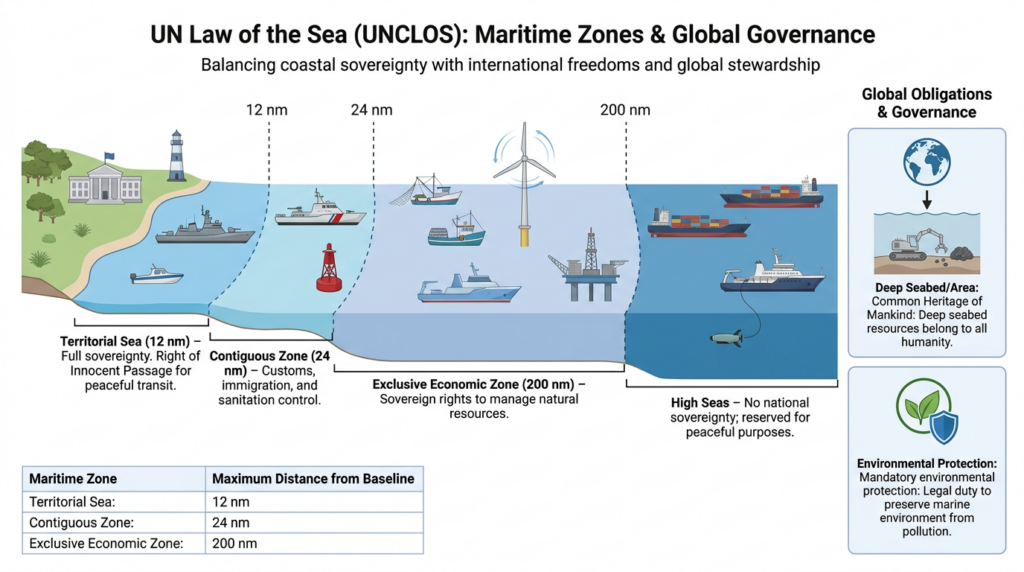
At its narrowest point, the Strait of Hormuz is just 21 nautical miles across—so narrow that the sovereign territorial waters of Iran and Oman overlap. The oil that routinely passes through this chokepoint accounts for one-fifth of global consumption; the portions of the world’s liquified natural gas, petrochemicals, and internationally traded fertilizer that make the transit are similar or even greater. The law of the sea must strike a balance here between the rights of the two nations that adjoin the strait and the global community’s need to keep a vital shipping artery open for navigation. Hormuz, as a result, is neither part of the “high seas” nor the exclusive preserve of Tehran and Muscat. This maritime bottleneck—youthful in oceanic terms, about 6,000 years old—thus also presents newly salient challenges to international law.
From the first hours of the war pitting Iranian against US and Israeli forces, images of oil tankers and cargo vessels stalled on either side of the strait have become familiar. As US bombers and Iranian missiles flew over the Persian Gulf to the west of the strait and the Sea of Oman to its east, shipping insurance premiums skyrocketed, making transit of the strait financially infeasible for many. The Islamic Revolution Guard Corps’ declaration in early March that the strait was closed to all but Iran’s own ships brought foreign navigation through the waterway to a near-complete halt. Compared to the prewar daily average of 138 vessels, roughly two ships a day took advantage of the Guards’ subsequent offer to allow passage in return for payment of a toll, before the US blockade shut down the strait almost entirely. All of these developments lead back to one question: Who actually has the right to decide who passes through Hormuz?
Under the 1958 Geneva Convention on the Territorial Sea, which Iran signed but never ratified and whose language it continues to reference, the division of such narrow waterways with different nations on either side is governed by the principle of the median line. According to this rule, unless the two countries agree otherwise, the boundary is a line where every point is equidistant from the nearest points on the baselines of each coast. This effectively splits the strait into two sectors of national sovereignty—every ship transiting Hormuz is always navigating within the sovereign territorial sea of either Iran or Oman.
A maritime highway
For decades, management of passage through the strait has followed this dual logic. The current routing system for vessels in Hormuz is the result of the Traffic Separation Scheme (TSS), which was jointly proposed by Iran and Oman and adopted by the International Maritime Organization (IMO) in 1968. The system was designed specifically to facilitate the safe, rapid transit of goods by establishing organized corridors for the heavy volume of traffic passing through the chokepoint.
Under the TSS, the strait functions like a strictly regulated maritime highway. To speed up transport and minimize the risk of accidents, Iran and Oman agreed on specific directions of travel: ships heading west and entering the Persian Gulf from the ocean would use an inbound lane that passes through Iranian territorial waters, while ships heading east and exiting the Gulf would follow an outbound lane through Omani waters.
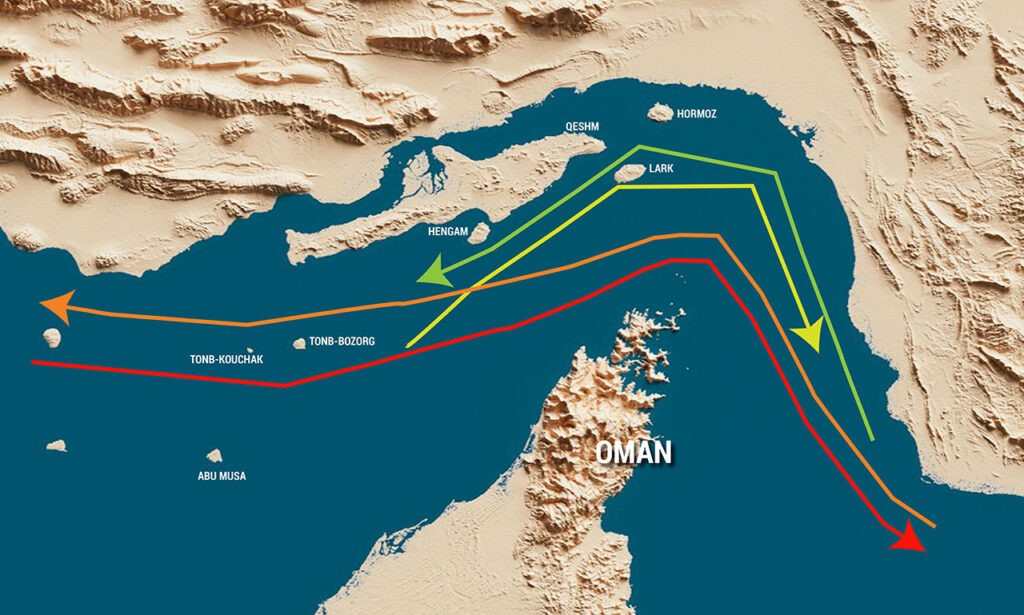
Because the tankers and container ships that traverse the strait are so massive—often exceeding 1,000 feet in length—they cannot simply choose alternate routes through the narrow gap. As on a divided land highway, a driver cannot suddenly decide to veer into the opposite lane or drive across the median whenever they please without risking a catastrophic collision. The TSS thus functionally locks ships into a system of designated lanes that relies on the cooperation of the two coastal states.
This technical reality is crucial because it demonstrates that the management of Hormuz is based not on claims of exclusive (or semiexclusive) ownership, but rather on navigation rules, regional coordination, and international recognition. While Tehran and Muscat have been the stewards of this system for decades, its approval by the IMO was never intended to grant them authority to close the waterway, impose arbitrary pricing, or selectively decide which ships are allowed to pass. Indeed, the IMO and the statutes of international law—such as Article 16(4) of the 1958 Territorial Sea Convention and Article 44 of the 1982 United Nations Convention on the Law of the Sea—consistently maintain that the right of transit through such a vital channel between international waters is a shared global necessity that cannot be suspended.
Exploiting the “gray zone”
To manage its confrontation with stronger adversaries in the strait, Tehran has developed what the analyst Michael Eisenstadt describes as a “gray zone” strategy—deploying legal ambiguity and strategic indirection to manufacture crises while controlling the pace of escalation and maintaining a veneer of statutory legitimacy. This is not a state navigating a genuine legal dispute in good faith. It is a government using the language of international law as a tool of coercion, selectively invoking whichever framework expands its leverage while discarding the obligations that would constrain it.
The clearest expression of this strategy is terminological. Iranian officials rarely cite the 1958 Geneva Convention by name, yet they reach consistently for its specific legal vocabulary when justifying their actions in the strait. In March 2026, Foreign Minister Abbas Araghchi stated directly that “Iran currently applies the innocent passage regime in the Strait of Hormuz.” The choice of “innocent passage” over the “transit passage” standard enshrined in the 1982 Convention is not casual. It is a deliberate reversion to a pre-1982 legal order that grants coastal states significantly broader authority to regulate, supervise, and, in certain circumstances, prohibit traffic through their territorial waters.
This preference for older statutory language has been codified in domestic law. Iran’s 1993 Act on Marine Areas is the formal architecture of its position, legislation designed to give statutory grounding to its physical control of the strait while sidestepping the obligations of international treaty. The Act selectively borrows from the international frameworks Iran finds useful while discarding those it does not. It adopts the UNCLOS standard of a 12-nautical-mile territorial sea—which, given the strait’s width of 21 miles, allows Iran to claim the entire northern half of the waterway as sovereign territory—while simultaneously omitting the transit passage rights that were the essential global bargain for accepting that broader limit in the first place. Article 5 of the Act formally endorses the 1958 “innocent passage” language. Article 8 grants Tehran the power to suspend passage for national security reasons, a power flatly prohibited under modern international law in straits used for international navigation. Articles 9 and 16 go further still, requiring prior authorization for all foreign warships and purporting to prohibit foreign military activity throughout Iran’s entire exclusive economic zone.
That selectivity is not incidental—it is the strategy. The 1993 Act is its domestic expression; the decision to sign the 1982 Convention without ratifying it is its international one. Signing alongside 88 other states allowed Iran to claim sovereign rights over the natural resources of a maritime area extending 200 nautical miles from its coast. By withholding ratification, Tehran preserved its status as a “persistent objector”—a recognized if contested principle in international law under which a state that consistently and openly rejects a norm during its formation cannot later be held bound by it. In its 1982 interpretive declaration, Iran argued that transit passage is merely a “contractual right” born of a package deal, binding only on states that have fully joined the treaty. This framing carries an additional tactical advantage: since the United States also never ratified UNCLOS, Iran can argue that Washington has no standing to invoke transit passage rights in Hormuz at all.
This strategy is widely regarded by international legal observers as a form of lawfare—the weaponization of legal language to achieve ends that the law itself would prohibit. The critique is pointed: Iran’s position is built on the 1958 framework it claims as its authority, yet Article 16(4) of that same convention explicitly prohibits the suspension of innocent passage through straits used for international navigation. In closing the strait to commerce it has designated hostile and conducting naval mining in one of the world’s most critical waterways, the Islamic Republic is not merely bending the rules—it is gutting the very framework it invokes for cover.
The United States, though it participated in drafting the navigational rules, declined to become a party to the treaty, rejecting its restrictions on deep seabed mining. Nonetheless, it argues that the transit passage regime has become so entrenched in international practice that it has crystallized into “customary international law”—binding on all states, including non-signatories like the US itself. (That Washington demands adherence to a treaty it has never joined is fodder for easy criticism. That it has now responded to Iran’s actions by imposing a blockade which violates recognized maritime law under any formula sets what some legal observers view as a dangerous precedent.)
Oman formally maintains a position somewhere in the middle of this statutory tug-of-war. While Muscat, unlike Tehran, both signed and ratified the 1982 Convention, it hardly adopted a maximalist reading of transit passage. In its “declarations made upon ratification,” Oman expressed concerns much like Iran’s regarding coastal sovereignty and the sensitivity of military vessels’ passage, asserting that foreign warships—along with all ships powered by or “carrying nuclear or other substances that are inherently dangerous or harmful to health or the environment”—must secure advance permission to traverse its territorial waters. There is no record, though, of Oman having even once impeded a vessel’s passage through the strait on this basis.
The law and the reality
Ultimately, Hormuz is neither entirely within nor beyond its two coastal states’ statutory control. The legal rights of Iran and Oman in the strait are real—and restricted. The restrictions stem directly from the unique role Hormuz plays in the global economy. If the strait were an entirely local body of water, the international community could afford its rules to be more localized. However, when a significant portion of the world’s oil, gas, and petroleum derivatives must pass through it, the waterway cannot be governed by the national security logic of a littoral state.
So who does have the right to decide who passes through Hormuz? Iran and Oman exercise sovereignty over their respective territorial seas, but this sovereignty is legally subject to international passage rights. These rights were established to ensure that a chokepoint of global importance could not be transformed into a single government’s lever of political pressure or weapon of war. This much is true: According to well-established, long-observed, explicitly articulated maritime law, any civilian vessel from anywhere on Earth has the right to pass through Hormuz under any circumstance. The current conflict, however, has demonstrated that this legal regime is not nearly robust enough to withstand the combined pressure of bombing, mining, drones, blockades, seaside arms, and the assertion of raw power, whether that of would-be regional heavyweight or planetary hegemon.
In 2026, the Strait of Hormuz is an arena neither for the realization of absolute Iranian sovereignty, nor for the cost-free triumph of the American-endorsed (if still unratified) principle of “freedom of navigation.” What has become clear is that the legal architecture intended to create a balance between coastal states, global commerce, and the rights of passing ships is more fragile than had been widely imagined. With the strait, as with so many other flashpoints of the international order, the law still commands rhetorical respect, but it no longer rules the waves.