
As millions sink into poverty and precarity rises for millions more, anger deepens.
Doctors lining up for food handouts at hospitals, well-heeled office workers buying groceries on credit, university students begging for bread at the bakery. These are just some of the examples of the daily struggles of Iran’s middle classes. After years of economic mismanagement, only compounded by the current international conflict, an entire social stratum is in danger of becoming structurally poor—or already there.
A highly educated generation raised on middle-class consumerism is facing economic deprivation, and knows it. As a result, Iran is confronting a redefinition of class and the rise of a new kind of political subject, one that the regime can neither placate with cash handouts nor silence without consequence.
As state-controlled media attempted to make sense of the gruesome massacres that followed January’s nationwide anti-government protests, an op-ed in Eghtesad News by entrepreneur and digital rights activist Nima Namdari pointed to an increasingly visible reality: Iran is no longer a society featuring a fairly clear and fixed division between the poor and middle classes. A liminal category of over 12 million people—what sociologist Asef Bayat has called the “poor middle class”—has become central to understanding the breadth and intensity of social unrest.
Around 8 million people have dropped below the poverty line since 2023, according to data from the World Bank and the Statistical Center of Iran. Add the country’s 4.5 million university students with precarious economic prospects to this group, and nearly one in every seven Iranians may be seen as falling into the poor middle class, even under a relatively narrow understanding of the term. In fact, many more people who might once have felt secure from economic hardship now routinely face it.
At the beginning of the 2010s, the middle class accounted for roughly 65 to 70 percent of the population. Over the past 15 years, however, its share has steadily declined due to economic sanctions, the lack of wealth redistribution, and the resulting persistence of high inflation and stagflation, falling to around 50 percent—about 47 million people—in recent years, according to state media. Interviews, media analyses, and reviews of social media accounts conducted by Resanegar, Tehran Bureau’s economic unit, suggest that the majority of this group is struggling to pay for daily basics.
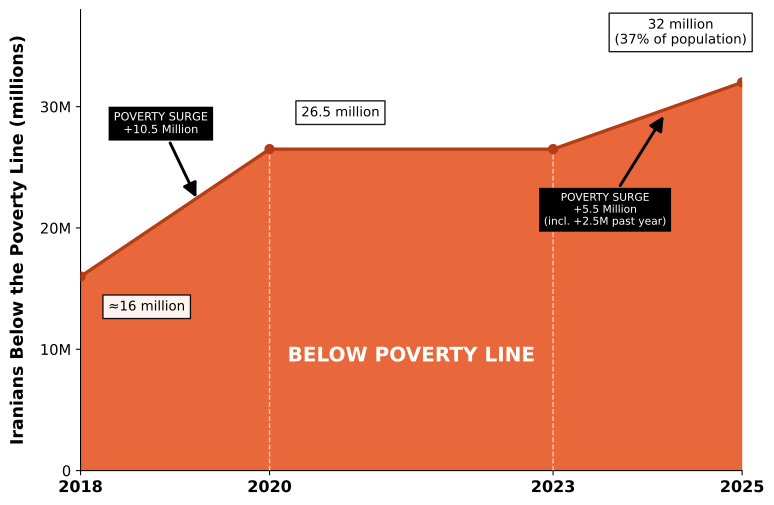
In total, roughly 37 percent of Iranians now live below the poverty line, including 2.5 million people whom the World Bank projects have fallen into this bracket just in the past year. The regime’s own experts acknowledge that the chronic stagnation of the past decade and a half has failed an entire generation. “There are about 12 million young people living in our country who are neither studying nor employed,” economist Masoud Nili wrote for the Islamic Republic News Agency in February. “That approximately 14 percent of the country’s population is inactive for exactly 24 hours” every day is contributing to the risk of “an uncontrollable explosion at any moment” in Iranian society. The number of employed Iranians has essentially been flat since 2019, he observed, “while more than 4.4 million people have been added to the population of the country aged 15 and over.”
Meanwhile, inflation and corruption are visibly exacerbating socioeconomic inequalities. Plunging oil revenues and tightened sanctions have led to the loss of welfare subsidies, while state funding for bonyads, opaque kleptocratic conglomerates posing as large charities, continues to flow. As a result, middle-class precarity, borderline poverty, and deep poverty all expand even as the wealth of the rich increases at a pace that not only matches but surpasses the extreme inflation rate, according to Nili.
More voices join chorus of economic grievance
The number of people living in poverty has increased in several stages since 2018, according to the Statistical Center of Iran. About 10.5 million people fell into poverty in 1397–1398 (March 2018–March 2020), and around 5.5 million more in 1402–1403 (2023–2025), bringing the total population below the poverty line to approximately 32 million people. By the end of 1403 (March 2025), net per capita income was 20 percent lower than in 1390 (2011) and 12 percent lower than in 1396 (2017).
The tangible result is a drastic decline in the quality of life, turning food items such as meat, dairy, and fruit into luxuries while imposing “serious limitations in access to medication and medical care for conditions that some people require urgently,” according to Nili.
And the lived contradictions go beyond the difficulty in meeting basic needs. Echoing Bayat’s analysis of the eruption of mass protests in December 2017, contentious politics in Iran are being redrawn by young Iranians who move fluently through Tehran’s cafés, universities, and online spaces, yet remain economically marginal. They access global culture digitally and know what life outside the Islamic Republic looks like, but they cannot access it. They aspire to have successful careers, stable homes and families, and the ability to travel, yet instead face violent repression and downward mobility.
“We are literally suffocating,” Mani, a Tehran-based film editor, told Resanegar, Tehran Bureau’s economic unit. “[The regime] deliberately keeps people poor so their only concern is earning their daily bread, and they have no time to think about protesting or anything else … Refrigerators are empty, people don’t have enough money to afford their daily food, rents are unpaid … Leisure, travel, everything has been cancelled.”
Despite their marginalization in an increasingly dysfunctional economy, the poor middle class wields the tools to reshape sociocultural boundaries. Scholars of contemporary Iran have often distinguished between protest movements led primarily by urban middle-class demands for political and cultural reform and those driven by lower-income groups mobilized around economic grievances. That distinction is now breaking down.
“When we were young, less educated people would become day laborers and construction workers, while educated people held important positions in the country. That is why parents used to place so much emphasis on education,” says Roya, a retiree from Tehran whose son earned a master’s degree in Canada. He now works as a delivery driver, Roya says, because he was “unable to work within the framework of this regime.”
Fault lines among the dispossessed
The poor middle class has helped reshape collective action, broadening participation across social strata while also intensifying the stakes. As Namdari’s op-ed suggests, recent demonstrations brought together millions of Iranians from across the lower, middle, and poor middle classes, only to be brutally suppressed. Yet the underlying pressures—economic malaise, political frustration, and social descent—remain unresolved.
“There was a time when you walked down Valiasr Street, the street vendors had a certain look about them, and you could tell they had come from small towns. Now you go there and see an artist painting right on the sidewalk, displaying their work for sale. Many of the vendors are well-dressed, respectable people. You can tell they are there simply to support their families,” says Roya. “It is like a capsized boat: people are drowning at the bottom, struggling to stay alive, while the scum rises to the surface.”
A common perception among the poor middle class is that the regime is exploiting the country’s woeful situation to co-opt people from the lowest social classes into the security apparatus, rewarding them with access to the few available employment opportunities.
“[Regime officials] think these people will become…mercenaries. They think [the traditionally poor] will fight for [them], report on others to [them],” says Roya. “All the mediocre, uneducated people who were willing to sell themselves for cheap have moved up, while educated people have ended up in low-level jobs.”
The resulting sense of injustice, amplified by the poor middle class group’s sense of superiority to the traditionally poor class, is likely to cause further political friction in Iran’s streets.
“The Islamic Republic will repeat its cycle,” Mani, the film editor, predicts. “Every ten years, it carries out a large-scale massacre, each time with a higher death toll. Every few years, someone from Iran wins the Nobel Peace Prize as a so-called opposition figure, but only the scale of killings grows larger, and people become poorer and more desperate.”