
One Tehrani’s account of the battle over Sanai Street and the capital’s public spaces.
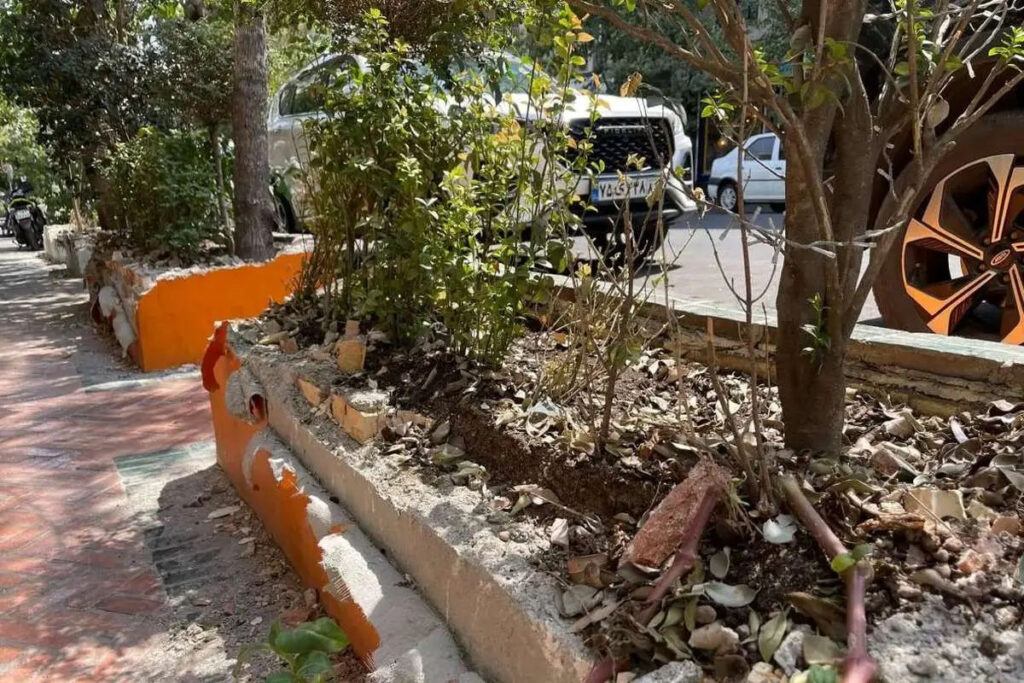
They came at night—not to arrest anyone, nor to seal yet another café. Without warning, they smashed the curbside planters and ledges, eliminating any surface on the sidewalks of Sanai Street where people might sit for a while and shoot the breeze. Closed down for a week or so, the cafés have since reopened, but the street is no longer the same.
Sanai Street runs for about fourteen blocks through central Tehran, from Karim Khan Zand Boulevard north to Shahid Motahari Street. The area’s residents are generally middle-class and upwardly mobile—to the extent that’s possible in the current economy. Many well-established publishing houses have their offices and bookstores in the neighborhood, which is close to the University of Tehran, the Amirkabir University of Technology, and the historic Alborz High School.
What happened on Sanai Street a few weeks ago is more than a story about a handful of coffeeshops having to temporarily shut down. It is about a seemingly endless struggle over control of public space.
On July 21, the Iranian Labour News Agency reported that unidentified individuals, in an overnight operation, used sledgehammers to destroy the raised concrete structures that double as seating areas on lower Sanai Street, leaving behind piles of debris and extensive damage to the sidewalk. Some see the destruction as part of an ongoing effort to eradicate informal gathering places (patoughs) from the city’s public spaces, settings where people can linger and converse.
The incident came only days after the government had ordered the closure of several cafés on the street. When they were allowed to reopen, many owners decided not to set up their usual outdoor tables and chairs for fear of further action.
To explore what is happening on Sanai Street, Resanegar, Tehran Bureau’s Persian-language website, spoke with a local resident. Saman, whose apartment is right next door to a café, was born in the late 1980s. As is increasingly common in urban Iran, in part due to the rising age of marriage, he lives alone. He spends his days working in the bazaar and his evenings and weekends on Sanai. For Saman, the street’s shops and cafés are not simply places to buy books or drink coffee. They are vital escapes from his often solitary existence, places to mingle and chat, to experience the hum of life going on around him.
Why did you choose Sanai Street as a place to live?
Because life flows through this street. My home is now surrounded by the bookstores and cafés where I like to spend my time. As someone who finds it difficult to talk and connect with family, acquaintances, and friends, it was very important for me to live somewhere that gave me easy access to the things that fill my solitude. That is how I feel about Sanai Street now, and I am happy to live here.
But didn’t they close the cafés on this street?
We are used to this kind of harassment. For about a week, they began closing the cafés on this street one by one. One afternoon, they came in from the top of the street and shut them down one after another.
Coming up Sanai Street from the lower end, the first café is Sam Café. A little farther up is Café 1401, which belongs to Ali Mosaffa, the film actor. Above that is Joe Café, followed by Café Ravello, Hamaan Café, and Do Bar Café.
From the beginning, Café 1401 had placed tables and chairs all along the pavement, and everyone sat outside. Joe Café had also become a very busy hangout on this street. Sanai Street has generally become very crowded because of these cafés and has turned into an important gathering place for young people in the area.
Apart from the cafés, there are also several older restaurants, such as Ciao, an Italian restaurant that is always very busy. When they began closing the cafés, they shut down all of them except Café Ravello. I don’t know why they left that one open, because there is no obvious difference between it and the others. They did not interfere with the restaurants either.
Which authority closed them?
As always, it was the police’s Public Places Supervision Department that closed the cafés.
Did they stop at closing the cafés?
No. Two days later, they came and destroyed the curbs and every place where young people used to sit, so that no one could sit there anymore. Just yesterday, they poured cement and asphalt over all the garden beds and levelled them, apparently to change the space completely.
Hamaan Café had a small garden in front of it. Inside the garden, they had built something like a box that people could sit inside. They destroyed the entire thing. Now the only place left to sit is the ledge beneath the café window.
Was the destruction also carried out by officers from the Public Places Department?
I don’t know, because they came during the night, destroyed everything, and left.
Are the cafés still closed?
No. The closures did not last longer than a week. First they reopened Sam Café, then Joe Café, then Do Bar Café, and finally the seals were removed from Café 1401.
Did it ever become clear why the cafés had been sealed?
No one knows exactly what their problem is. Apparently, they do not want anyone sitting outside on this street or turning it into a gathering place.
It certainly had nothing to do with traffic, because the real traffic on Sanai Street is farther up, near Ciao Restaurant. There is not much traffic on the lower part of the street. They also did nothing to the restaurants farther up, even though those places are crowded too.
What do the café owners say?
From what I have heard, apparently every so often they close the cafés, take some money, and then allow them to reopen. But I don’t think that is the only reason. There must be something else going on behind the scenes.
Could it have been because the customers or café owners were not observing the hijab?
I don’t think so, because nothing changed in terms of hijab before and after the closures. Not wearing the hijab has become almost normal. Many people walk along this street without one.
There are many children’s clothing shops here, and most of their customers do not wear the hijab. Many people come here just to take a walk, and they walk through the street without covering their hair.
Besides, if hijab were their only concern, Iran-Shahr Street, a little farther down, is a much larger and busier gathering place. Iran-Shahr has completely turned into a hangout for young people. Everyone sits on the pavements, and many women are not wearing hijab, but they did not interfere with the cafés there. There must be some other reason besides hijab.
Don’t you think they may have decided to eliminate these gathering places altogether and have simply started with Sanai Street?
They can’t. How could they eliminate them? If they shut down one neighborhood, the young people will simply turn up in another one. This is the only pleasure young people have left. How could they take even this away from them?
What happened when they closed the cafés on Sanai Street?
Nothing. The street became quiet for a week. The people who normally came here went to Iran-Shahr Street instead. In fact, Iran-Shahr became even more crowded.
From six or seven in the evening, girls and boys bring whatever they have made and set up stalls to sell it. The whole street has become a lively recreational gathering place.
It used to be mostly a center for shops selling printers and computer equipment. Now nearly all of those businesses have disappeared, and cafés have taken their place.
Karim Khan [Boulevard] has changed in the same way. The ground floors of the buildings have become cafés or restaurants, while the upper floors are used for selling accessories, handicrafts, and similar things.
Sanai and Iran-Shahr streets are completely different from the rest of Tehran, both in the way people dress and look and in their streetscape. They provide a cozy environment for people who want to escape the stress and anxiety of Tehran’s turbulent days.
Did the customers protest against the café closures?
No. No one did. Everyone passed by indifferently. They were only thinking about where else they could go if they could no longer come here.
What did the system gain from it?
Honestly, I don’t know. They destroyed every place where people could sit, but the café owners will certainly come up with another arrangement so they can keep their customers.
Don’t you think this project may be part of a strategy to take the streets away from protesters? Perhaps they do not want protesters to have any presence in the streets, even in the form of a nighttime gathering place.
I spent all forty days of the war in my apartment on Sanai Street. I did not go anywhere. Nothing unusual happened here.
They would only make the street a little darker than usual from around five or six in the evening to discourage people from going out. But there were no government rallies, displays of self-sacrifice, or anything of that sort here.
From inside our apartment, I would only see groups of government supporters passing through on their way toward Takht-e Tavous Street, and from there toward Valiasr and Vanak.
On Valiasr Street, they would close off one side of the road. They had religious stalls and tents, chanting, and organised gatherings. But nothing like that happened on Sanai Street. They only set up a checkpoint for a few nights.
From the beginning of the war, ordinary people did not use the city’s main streets and major squares. Those areas were completely controlled by government forces. But they were not present in the smaller side streets and alleys around places such as Sanai, where there are many cafés. People came and went sporadically. Many people came out to walk their dogs, and no one bothered anyone else.
What did you do when the cafés were closed? How did you feel?
I usually come home from work at around five or six. I take a shower, change my clothes, and go out. First, I visit the bookstores and stand there reading a few pages of a book. Then I go to Hamaan Café, sit down, and have something to eat or drink.
Late at night, I go home, play with my cats for a while, take care of them, and then go to sleep. On some evenings, I have an art class, and I spend my time with the people from the workshop.
But when they close the cafés and darken the streets, it means that life has been shut down. I have to sit at home and watch the silence of the city through the window, although I do so with the hope that one day these people will no longer be here.
Is it the same for everyone else?
Some people go to another hangout when one closes, but I don’t like going into just any environment and seeing unfamiliar faces.
There are many cafés in the side streets and alleys around Sanai that they did not interfere with. I don’t know what their problem is with the main street.
What are the café owners doing?
Even under normal circumstances, with prices rising like this, their situation is not good. These poor people have to pay monthly rents of 400 or 500 million [tomans; roughly $2,100–2,625 USD]. I don’t know how they manage to come up with that money every month.
All I know is that when they close the cafés, they deprive many people of their livelihoods. Recently, they were closed for ten days because of Muharram, then for another ten days because of the Leader’s funeral ceremonies. After that, the authorities came and sealed them for no reason.
How is a café owner supposed to pay the rent at the end of the month and pay the workers? That is why so many cafés close voluntarily after a year. In the current situation, it is extremely difficult to keep a business going.
How do you see the general mood of society after the war, or perhaps we should say under the present circumstances? Have people returned to ordinary life, or are they living in fear and uncertainty?
There is a distressing sense of uncertainty hanging over everything. Almost everyone I encounter at work or at the art school complains about it.
No one knows what will happen tomorrow, so no one has any plans for their life. Nearly all plans have been put on hold. Some people have become so exhausted that all they wish for is a return to the conditions before the war.
At the same time, many people, including me, still hope for change and are waiting to see what happens.
Just a few minutes ago, I was speaking to two people in the café. They were waiting for the main event. They said the situation could not remain like this.
Nothing is more painful than imagining that the blood shed during all of this may have been wasted. Society has already lost so many people. All that blood could not have been shed for nothing.
You can see a contradictory atmosphere. Some people are still hopeful, while others have completely lost hope and believe that these people will never leave, whatever the cost.
Someone in the café said, “As long as they are here, they want us to live in misery. At least this war has forced them to live under the same conditions as us. The fact that they do not know where they can safely sleep at night is enough to make them understand the condition of the people a little better. Let them live in fear and terror for a while. Let them taste misery too.”
Are there signs that the government is governing from a position of fear?
Yes. The fact that they have wanted to raise the price of gasoline for some time but have not dared to do it is a sign of their fear.
They can no longer make a decision overnight, as they did in the past, and suddenly increase gasoline prices. Although, in practice, they have already raised the price by reducing people’s subsidised gasoline quotas, forcing them to use more gasoline sold at the higher, non-quota price.
Before the war, the government and parliament were fighting over the implementation of the hijab law, and in the end the government refused to implement it. Don’t you think they may now try to enforce that law?
I heard that cafés in Mashhad were closed because of the hijab issue. But in Tehran, hijab enforcement has slipped completely out of their control. Hijab is not their main concern at the moment.
Perhaps, once they are no longer worried about the war, they will start harassing people over it again. But for now, they do not have an opportunity to intervene in the hijab issue, at least not in Tehran.
Even in the Tehran bazaar, you can see how much people have come to accept the situation. You see women and girls, some wearing hijab and others without it, walking and shopping together. It has actually created a very beautiful atmosphere.
During the war, convoys of pro-government motorcyclists would pass through Sanai Street shouting. Sometimes they threatened women who were not wearing hijab. You could hear them from inside the apartment, or see the hatred they felt toward unveiled women on their faces.
But at least it has not yet become the government’s priority to confront women over hijab. Once they regain their footing, however, they will probably revive the compulsory hijab policy.
First, they will try to force girls and women back into compulsory hijab by cutting off employment and financial opportunities and taking away quotas and privileges. Then they will resort to arrests and crackdowns.
What do you think would need to happen for people to begin feeling a little better?
Under present conditions, when hope for change has faded, I genuinely believe that an improvement in the economic situation could provide some relief.
But as someone who has some involvement in the market, I believe the economic situation will become worse rather than better, because there is no rationality in this government.
Neither its foreign policy nor its domestic policy is based on rational decision-making. The decisions are emotional, and you cannot put an economy in order through emotional decisions.
Another point is that people would feel better if they sensed that the government had become even slightly more flexible.
Even if people felt that the government was fighting this battle in defence of their interests, they would feel better. But many do not feel that way. Many believe the government does not make decisions for the well-being of the people, but starts fires in pursuit of its own interests.
So you think people do not believe the government’s account of the confrontation in the Strait of Hormuz?
Apart from the government’s own supporters, who believe whatever it says, no one pays attention to these claims.
People’s knowledge, even their military knowledge, has increased tremendously. It is no longer easy to pull the wool over anyone’s eyes.
At the art class I attend, I see students using international websites to monitor the routes of aircraft, ships, and other movements around the Strait of Hormuz from moment to moment. They know what is happening.
Everyone has become an analyst. People follow the news in such detail that they have developed the ability to analyze it. They put different reports together and understand which accounts are closer to reality.
The only exception is the segment of society that wants the government’s account to be true and therefore repeats it.
When do you think society will reach its breaking point?
People have already had enough. Their patience has run out.
To get through everyday life now, you have to eliminate some of your needs so that you can meet the others. In order to afford daily necessities, you have to postpone medical tests and doctors’ appointments. That is the situation for many people.
The government understands this very well, which is why it is making a very calculated effort to control the situation. Its entire effort is directed toward preventing another protest movement from taking shape. But no one knows how long it will succeed.