
An eyewitness recalls the 1999 events that made clear the regime would “use any level of violence to preserve itself,” including Ahmadinejad’s role.
The Kooy-e Daneshgah protests of 1999 were among the largest instances of Iranian student activism since the 1979 Revolution and are widely regarded as a turning point, the first in what built into a flood of at least 60 major episodes of unrest, from local and regional protests to nationwide uprisings, during Ali Khamenei’s last 27 years as Supreme Leader. Campus demonstrations were nothing new; what was unprecedented in July 1999 was the level of violence deployed by the regime against university students and, triggered by that violence, young people’s demands for fundamental transformation of the Islamic Republic.
The initial motive for the protests involved Salam, a leading reformist newspaper that had provided crucial support for Mohammad Khatami’s successful 1997 presidential campaign. On July 6, the paper published a leaked confidential letter written a year earlier by Saeed Emami, a senior Intelligence Ministry official, to the ministry’s chief, Qorban-Ali Dorri-Najafabadi. The letter called for tighter controls on the press and identified several journalists as threats to national security, including Mohammad Mokhtari, who was murdered a few months after the letter was written, in December 1998. His killing was one of what became known as the Chain Murders, a series of assassinations of intellectuals and dissidents that also claimed the lives of other prominent figures such as Dariush and Parvaneh Forouhar. Emami was arrested in February 1999 and died under suspicious circumstances in prison on June 20, 1999.
The day after the publication of his letter, July 7, the Majles approved a legislative amendment granting judges broader powers in cases involving the media and news coverage, while making juries’ role largely advisory. The amendment was widely seen as part of a broader crackdown on the reformist press—a view confirmed when Salam was closed the same day by court order. Students at the University of Tehran responded by staging a protest on July 8, a Thursday, against both the newspaper’s closure and the general tightening of press restrictions.
In the predawn hours of Friday, July 9 (18 Tir), security forces, including military and paramilitary units as well as plainclothes agents, raided the University of Tehran dormitory complex, known as Kooy-e Daneshgah. They beat, injured, and arrested many students and set fire to several buildings. One student, Fereshteh Alizadeh, visiting from Alzahra University in north Tehran, disappeared during the raid. She was never heard from again. A second, Saeed Zeinali, was arrested in its immediate aftermath. Aside from a single phone call to his family, three months later, he was never heard from again.
Following the raid, the protests swiftly escalated, with students barricading themselves in the dormitory, holding mass rallies on campus, and clashing with security details and regime-aligned thugs on the streets. They became the first major protests in Iran to call explicitly for the ouster of Supreme Leader Khamenei. On July 11, the unrest spread to Tabriz, where students gathered to protest the regime and what was taking place in the capital. After several days of chaos in and around the University of Tehran, the intensity of the regime forces’ violence and students’ recognition of how incapable President Khatami’s nominally reformist administration was of restraining it brought an end to the uprising.
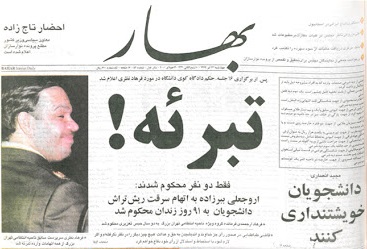
Two years after the Kooy incident, a number of individuals who participated in the dormitory attack were tried on various charges; all were acquitted except Oroujali Babarzadeh, a conscripted soldier who was convicted of stealing an electric razor during the raid. Despite this mark on his record, he was later employed by the police force, where he rose to the rank of colonel.
As part of an ongoing Tehran Bureau oral history project, journalist Pezhman Tahavori, who gained access to Kooy-e Daneshgah on the morning of July 9, describes what he witnessed there, on the rest of campus, and at nearby scenes of unrest over the following four and a half days; he also reflects on Khamenei’s lengthy reign. A lead reporter for Iran, the official government daily, Tahavori began covering parliament for the newspaper in 1998 and resigned seven years later, after Mahmoud Ahmadinejad became president.
Ahmadinejad’s involvement with the Basij, the militia that operates under the aegis of the Islamic Revolutionary Guard Corps, has long been rumored. Between 1997, when he was replaced as governor of Ardabil province by Khatami, and 2003, when he was elected mayor of Tehran, Ahmadinejad received his doctorate in traffic and transport engineering from the Iran University of Science and Technology in northeast Tehran, lectured there, and twice ran unsuccessfully for public office.
In Revolutionary Iran: A History of the Islamic Republic, Michael Axworthy describes Ahmadinejad during this period as having “close connections to the Ansar-e Hezbollah street fighters who periodically broke into offices or disrupted meetings of the reformists…enforce[d] hejab…[and] reprimand[ed] couples holding hands in parks. Many of them were present or former members of the Basij.” The extent of those “close connections” has not previously been clear. Tahavori’s eyewitness account of the future president leading an attack by motorcycle-riding brawlers on the offices of the Islamic Republic News Agency on July 12, 1999, is the first such account on the record.
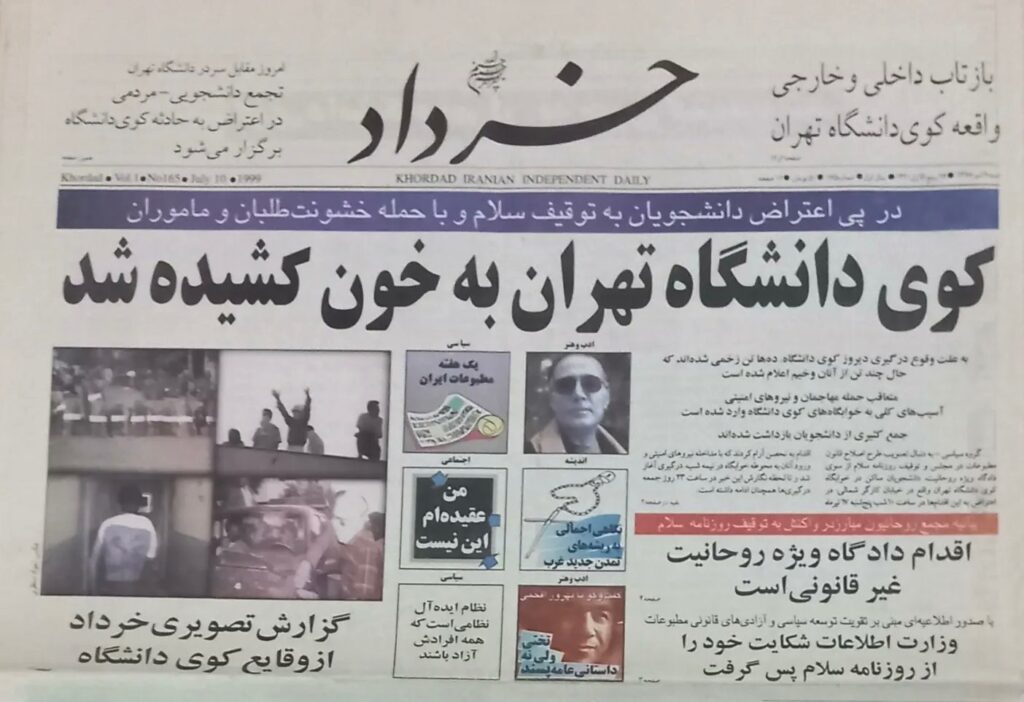
I was the first one to arrive at Kooy-e Daneshgah and the last to leave. When I got there, I was the only reporter on the scene. I stayed there from Friday until Tuesday night, when it was all over. I was there around the clock. When they attacked the Kooy on Thursday night, there were no reporters there, and no one really knew what had happened. But by Friday night, the place was crowded with journalists from all the media outlets because the news had reached everyone by then.
In Iran, [newspaper] journalists have Thursdays off and work on Fridays. We usually went into the newsroom around noon on Fridays to put together the Saturday morning edition. I usually went hiking on Thursdays. But unlike my usual routine, I went hiking early that Friday morning. When I came down from the mountain, I thought, I might as well go to the office, get my reports ready, finish up, and head home early. I didn’t want to have to stay until seven or eight that evening.
When I arrived at the Iran newsroom at around 9:30 a.m., Mr. Bolouri, a well-respected journalist, was the only person there. I went over to the political desk and noticed that the message light on our office phone was blinking. We had three unheard voicemail messages. The first two weren’t important, but the third was from a young man whose voice was panicked: “Hurry! They blew up Tahkim [Vahdat]’s office last night, and killed everyone there.”
I immediately went to get Mr. Bolouri. He came over, listened to the message, and said, “Go to Tahkim and see what’s going on.”
Before leaving, it occurred to me to call Ali Afshari, who was then the secretary of Daftar-e Tahkim-e Vahdat [Office for Strengthening Unity, a national student organization], and see what he knew.
Tahkim-e Vahdat had an old building in the back streets off Jomhouri Street where they held some of their meetings and gatherings. Based on the voicemail, I assumed that was the building that had been blown up. But when I called Afshari’s home number, he answered. I asked, “Ali, what’s going on?”
“Nothing happened at Tahkim last night,” he said. “They attacked the Kooy-e Daneshgah. Apparently things were pretty chaotic, but I haven’t gone there myself yet. That’s just what I’ve been told.”
I immediately got a car and went to Amirabad [St. and Keshavarz Blvd.]. When I got there, police had completely blocked off North Amirabad. There were a lot of Honda motorcycles there…the ones Basij members are always riding around on. The place was crawling with Basijis.
I started walking toward the dormitory, but the police were not letting anyone pass unless they asked questions and made sure the person actually lived in one of the nearby alleys. I asked a soldier, “Who is your commander?”
He pointed me to a police colonel. I went over to him and did the whole polite routine: hello, how are you, khaste nabashid [roughly, “excuse me, sorry to bother you”], khoda ghovat [roughly, “you’re working so hard”], and so on. I told him, “I’m a journalist. I’m here to cover the news, and I want to go inside.”
He said, “If you have the guts, go right ahead.” Those were his exact words. I said, “Okay, thank you very much.” He opened the gate. As I was about to pass through, he called me back and said, “I don’t think you understood what I said. If you go up there, the students will hit you with rocks. You can go if you want to, but be very careful..”
Back in the day, we all carried a clipboard with brown paper sheets that had the newspaper’s logo on them, which we used as a writing pad. I had that clipboard and the papers in my hands, and my recorder was in my pocket.
As I got close to the Kooy entrance, rocks started flying toward me. I don’t know where they had gotten the rocks from, but the whole area was full of them. Maybe there was a construction site nearby, or maybe they had gathered them from the garden beds … The students were throwing rocks at anyone who tried to approach.
I held the clipboard over my head and shouted, “Stop throwing! I’m a journalist!” I wasn’t afraid. I kept moving forward … A few rocks hit me, but I made it.
When I reached the young men throwing rocks, they started pulling me in every direction, and I kept telling them I was there to cover the news. My impression was that I was the first journalist to get in, because they immediately started debating whether they should let journalists in at all. That initial group that had gathered there hadn’t thought that far ahead. Then one of them shouted, “Only let the reformist journalists in.”
That was the era of reformist newspapers, after all. When I told them, “I’m a reporter for Iran newspaper,” the question became: Was Iran a reformist newspaper or not? I went back and forth with them for quite a while trying to convince them.
Until that day, there had been a great deal of uncertainty about Iran newspaper. After all, it had long been regarded as [Akbar] Hashemi Rafsanjani‘s platform and had supported [Ali Akbar] Nategh [Nouri], so the public viewed it very differently. But Iran ended up surprising everyone.
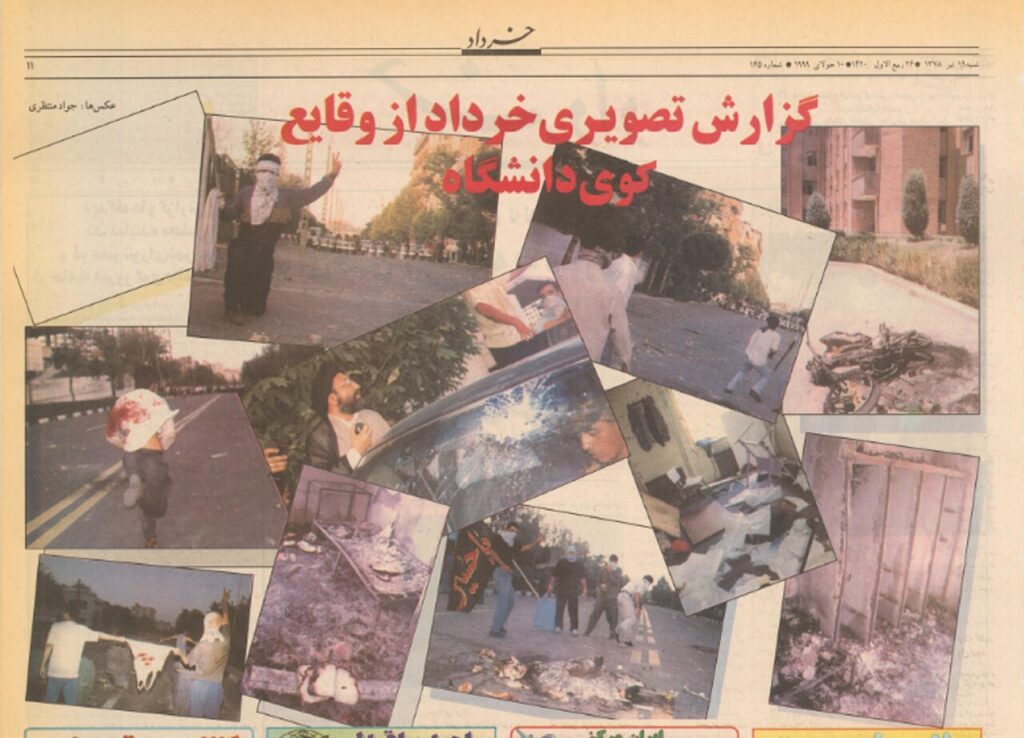
When I entered the Kooy, I saw blood everywhere; all the students there were injured. Their bodies were covered with wounds, and their clothes were covered in blood. There were signs of clashes, and the attackers had completely burned down several areas. I noticed there were a lot of young men and women holding bloodied clothes up in the air. They were chanting. There were some highly charged slogans.
Later, when that photo of Ahmad Batebi was published and he was arrested, I always felt, as someone who had witnessed that scene, that he had been singled out. Many other people were holding up bloodied shirts that day. I don’t know whether Ahmad Batebi had already been under surveillance before then, but that photo, and that pose, were not unique to him. Many young men were holding their shirts up like that.
I started asking everyone who the attackers were. The only person whose name everyone knew and whom they had seen was Masoud Dehnamaki. So, in my report that was published in Iran the next day, I wrote that Masoud Dehnamaki had commanded the attack on the dorm. Dehnamaki sued Iran over that report. But he never said, “I wasn’t there that night” in court. He said, “I was there that night, but as an observer. I was not involved in those things. I did not beat anyone.” The court ruled in favor of Iran newspaper, which confirmed that my report was correct.
Around 11 a.m., I was standing in front of the Kooy when Faezeh Hashemi’s car pulled up. She was the first person to enter the dormitory for an inspection. I was a parliamentary reporter at the time and knew her from parliament, and she knew me too. I went over and greeted her. Faezeh asked me what was going on. I said, “You have to see it for yourself. It’s not something I can describe.”
Faezeh and I went through the halls one by one. The police were with us too. One of the dormitories that had been set on fire was for visually impaired students. These poor students were crying. They said they didn’t know what was happening, but they could hear people crying out in pain, people being beaten, and then they could smell something burning.
It was very shocking. It was a very painful moment to see what had happened there.
Some time after all of this, I was at a gathering at the home of a well-known film director. One of the directors there said something interesting, and I really don’t know how credible it was. He said the main reason they attacked Kooy-e Daneshgah that night was not over the Salam newspaper issue.
The young man who was killed during that incident, Ezzat Ebrahimnejad, was a conscript. He was not actually a student, but he was killed inside the dormitory. He told me that this young man had taken a copy of the actual confession videos of Saeed Emami, which were classified, out of his barracks. They had attacked the dormitory to find that video, and when they couldn’t find it, they set fire to several buildings where they suspected the video might have been.
He was not someone who had firsthand knowledge of it. He said that someone who worked with the security apparatus had told him this and asked him to make a film about it. But he said he was afraid of getting caught up in the rivalries between Iran’s intelligence organizations, because he believed the IRGC [Islamic Revolutionary Guard Corps] was behind the attack. He said the Ministry of Intelligence wanted this information to come out and wanted a film to be made about it. That director said he was afraid of getting involved in this game, but he said he thought it was an interesting subject to make a film about.
Around 1 p.m. on Friday, two buses pulled up and dropped off a large number of students. They were students who had been beaten and taken away the night before. They all had bandaged heads, their faces were bruised, and some had broken arms that had been wrapped and splinted. You couldn’t tell whether they were being brought back from a clinic or from a detention center, but whatever the case, no one dared to speak. When you tried to talk to them, they refused to say anything. The buses that brought them back were IRGC buses.
The atmosphere at the university was very tense that day. All the officials started coming one by one. Abdollah Nouri came. [Mostafa] Tajzadeh came. The Khatami administration was doing everything they could to calm the students because they did not want the situation to become more inflamed.
The students were divided into two camps, and you could clearly see this division inside the Kooy. On one side were the Tahkim-e Vahdat students; on the other was the United Student Front, led by [Heshmatollah] Tabarzadi. The United Student Front’s views did not fit within the framework of reformism, nor did its members consider themselves reformists in that sense.
Tahkim students were trying to bring everyone back inside the Kooy, hold their gathering there, and keep the protests inside the dormitory. But the United Student Front kept trying to move the crowd outside, saying that they had to go toward the Beyt [Beyt e-Rahbari, headquarters of the Supreme Leader].
I remember that Mr. Tajzadeh gathered the members of the Central Council of Tahkim. At the time, that was Afshari…, Akbar Atri, and several others. He told them very firmly not to let students out of the Kooy, and to hold them there by any means necessary.
I heard this directly from Tajzadeh. “The IRGC has warned that if students set foot on Enghelab Street, we will open fire on all of them. No one should even think about going toward the Beyt.”
The United Student Front was viewed as somewhat suspicious. They had managed to find some supporters on university campuses, but they did not have a very strong base, because at that time Tahkim had almost complete dominance over universities across Iran.
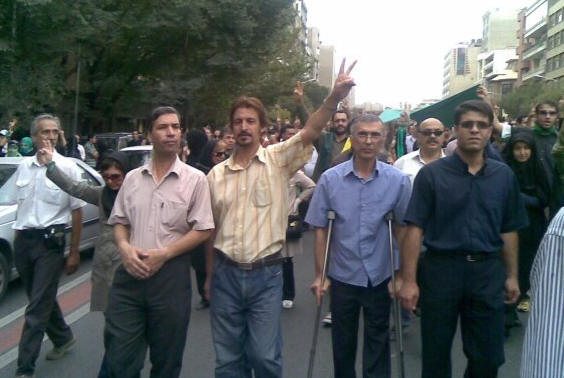
The reason I say people were skeptical of them was that Tabarzadi was the one who first promoted “Imam Khamenei” in his magazine. For a period during the Hashemi era, they attacked and criticized Hashemi. Then he started the “Imam Khamenei” thing, and he also published a university magazine that many people considered very hardline. Then suddenly, he switched to this side. Political observers were suspicious of them because they thought these people were working for the security apparatus. But I cannot really say whether those suspicions were correct or not.
One interesting thing I can mention is that a few days after the Kooy events, [state] television aired the confession videos of Manouchehr Mohammadi, his brother, and some other United Student Front members who had been arrested.
Three days before the Kooy incident, there was a gathering at the Faculty of Medicine at the University of Tehran that I had gone to cover. I don’t remember who the speaker was, but I do remember that the hall was packed. I was sitting in the front row, taking notes, when a student came over and whispered in my ear, “There’s a crowd at the entrance to the University of Tehran. I think you might find it interesting.” That was all he said to me, and then he left.
There were a lot of reporters in that hall, and I felt that if something had really happened at the university entrance, that was more important. So I got up and went to the entrance.
When I got there, I saw that the United Student Front group, Tabarzadi and the others, had gathered at the entrance. The Basijis had also gathered there. They were taunting each other, trading challenges, and chanting slogans when it suddenly turned into a physical confrontation. One of Tabarzadi’s people was making a big scene and causing a lot of commotion.
I don’t know whether these Basijis were from the Ministry of Intelligence, the IRGC, or somewhere else, but they were people who were clearly security types, the kind who wore their shirts untucked over their pants. I was watching all of this happen right in front of me. Without drawing anyone’s attention, they grabbed this guy from behind, pulled him out of the crowd, put him on a motorcycle, and took off.
When they aired the confession videos of the Mohammadi brothers, I realized that they were showing that same guy and footage from the gatherings at the University of Tehran entrance as footage from Thursday night, the night of the attack. They were passing off the unrest and destruction from that day as if it had happened at the Kooy.
Since I had been there myself, I immediately told the photographer, “I need these photos.” Because wherever I went to cover a story, I took a photographer with me. I had the photography department print all those photos, along with the footage from the video they had broadcast. We put them side by side, and I was right. These gatherings, and the confessions they were showing, none of them had anything to do with the Kooy. They were all from three days before the Kooy incident.
I took all of this to Mr. [Fereydoun] Vardi-Nejad’s office, who was the managing director of the newspaper and also held a media-related position at the Supreme National Security Council. He was very surprised. He said, “This is a very important story. I need to send this to the president’s office right away.” So I handed it to him, and he took it from there.
The university was very crowded on Friday, and the clashes on campus became very intense that night. The next day, there was a gathering in front of the university. A lot of people came. It was one of the largest student gatherings of that decade. Once it ended, the students went back to the Kooy.
On Saturday night, the Basijis came to Amirabad Street. The police had set up a barricade. The Basijis were behind the police, and the students were on the other side. Students were throwing stones, and police were firing tear gas.
Suddenly, an elderly woman, who looked to be around 70, maybe 67 or 68, walked over to the group of students with covered faces who were chanting the most radical slogans. She handed them a container and said, “There’s gasoline in here. Go make Molotov cocktails and defend yourselves. You won’t be able to take them on with rocks.” Those were her exact words.
It was as if they had suddenly discovered a new source of strength. They immediately ran to the dormitory cafeteria, grabbed empty soda bottles, filled them with gasoline, lit them, and started throwing them toward the other side.
Where that woman had come from is a mystery. She appeared, handed them the gasoline, and disappeared. I don’t think anyone else even noticed her. I just happened to be standing there at that moment. This is something I saw with my own eyes.
There were probably things going on behind the scenes. At that time, the reform movement was getting stronger every day and gaining a more serious base of support. The system was afraid, genuinely afraid, because they had completely lost the parliamentary elections. I remember when the election results were announced, the incumbent members of parliament were losing their minds. A group of us parliamentary reporters went to Ayatollah [Mohammad Reza] Faker. I asked him, “What do you think about what happened?” He knocked my recorder out of my hand and threw it aside. He said, “You journalists, these newspapers, you destroyed [everything]…”
That was the atmosphere. They were very afraid of the reform movement and wanted to regain control. This system has always shown that whenever it wants to control something, it resorts to violence because it knows that in a violent confrontation, it has the upper hand.
Everyone was still at the Kooy on Sunday. If I remember correctly, that was the day of the Esteghlal–Persepolis [football] match. The United Student Front people were pushing the idea that we should get the crowds coming back from the stadium to join us and take the gathering out onto the streets. But the Tahkim students were trying to keep them inside the Kooy. They brought Ezzatollah Sahabi to persuade the students not to go out.
I remember Sahabi’s speech was the most calming speech a political figure could have delivered under those circumstances; he told students not to get drawn into any confrontations. But when Ali Afshari and Ezzatollah Sahabi were tried, they were portrayed as the people who had incited the students. I wanted to go and testify that what the court was alleging against Afshari and Sahabi was completely false. But Vardi-Nejad wouldn’t let me. He said, “You’re a journalist, and you shouldn’t get involved in this.” But I was genuinely prepared to testify in court.
On Monday, we were not at the Kooy. The gathering was on campus. Professors had announced a gathering at the university mosque, so we went there. They announced a sit-in in the university prayer hall after the noon prayers and Basijis attacked that sit-in. The Basijis had a plan. They wanted to turn gatherings violent so they could crack down and bring the situation under control. They abandoned the restraint they had shown during the first day or two, when they had stepped back somewhat and were mostly standing by and watching. After the attack on the prayer hall, the students moved into the street above [campus], toward Keshavarz Boulevard, and the clashes became very intense.
There were also acts of vandalism in the [Tehran Grand] Bazaar and elsewhere to create the impression that there was widespread unrest and chaos. They had simultaneously started [to escalate tensions on multiple fronts to [justify the] crackdown on the students. They bussed obash [thugs] into the bazaar, and they started attacking people’s shops. Ahmadinejad gathered his goons, and they attacked a news agency.
I was calling the newspaper almost every hour to let them know what was happening and what was going on. That day was pure chaos. I was around Valiasr Square when I heard the news. When I called, they told me there was chaos in the bazaar but you should go to the news agency. The Islamic Republic News Agency’s office was further up Valiasr Street. You had to go a little farther up Valiasr Street [from the square] to reach it.
Back then, Ahmadinejad was the head of the Professors Basij. We had the Student Basij and the Professors Basij, and he was also a member of the Islamic Society of Engineers, which was headed by [Mohammad Reza] Bahonar. Ahmadinejad was leading the enforcers. He was one of the club-wielding thugs.
I saw Ahmadinejad with my own eyes. He and his motorcycle-riding club-wielders had attacked the news agency. There weren’t just one or two of them; there were at least 50 motorcyclists. Some were carrying clubs, others were carrying flags. The news agency had immediately called the police, who had surrounded the building to prevent [the thugs] from entering or damaging the building and its windows. If someone has access, it’s all in the agency’s wire reports. You can find it in the archives.
I don’t remember whether they had broken any windows or not, but they had created a very tense atmosphere overall. I’m telling you, they were riding motorcycles from one side of the city to the other, wreaking havoc.
Around four or five in the afternoon, when students were leaving campus, they started beating them. I witnessed scenes of direct gunfire. At one point, a bullet struck a tree branch above my head, and it fell right in front of me. They were not firing directly at the students; they were shooting into the air, but it created an incredible sense of fear.
Khamenei’s initial reaction was actually very sympathetic toward the students. He tried to reassure them. He gave a speech and said, “Even if the students tore up my picture, even if they said things [about me], no one should retaliate.” He downplayed it as an incident that had occurred and instructed the judiciary to look into the matter. He adopted a somewhat fatherly stance.
But that fatherly posture was only for show. Despite his public display of sympathy, Khamenei unleashed the Revolutionary Guards on the students and the IRGC attacked the very next day.
On that final night, they had created an atmosphere of sheer terror. Earlier that afternoon, they had opened fire on the students, forcing them to flee. Once it got dark, around dusk, there was not a single student left in the streets. The entire length of Amirabad Street had been taken over by the Revolutionary Guards and the Basij.
Back then, we didn’t have mobile phones or anything like that. We would call the newspaper from public phone booths near the dorms, read our reports and news updates over the phone, and they would write them down and publish them. The only people going back and forth between the newspaper and the university were the photographers, who delivered rolls of film so they could be developed and printed. That night, I called the newspaper, and [my editor] Nouri said, “I’m coming tonight.”
Before becoming Iran newspaper’s political editor, Mr. Nouri had been in the Revolutionary Guards with Vardi-Nejad, and Vardi-Nejad had brought [a few of] them from the Guards to work at the paper.
He came, and Mr. Nouri and I went to see what was happening at the dorms. The IRGC had sealed off the area and wouldn’t let anyone enter. There were also vans with metal grills that they had placed throughout the streets. Anyone they suspected was a student or mokhalef [opposed to the regime], they would immediately shove into those vans and take away. I saw a few young people shoved into the vans like that. I remember seeing a woman stop and start shouting [in protest] when she saw this. They beat her with a club, threw her in the same van, and took her away.
After having spent four or five days and nights there, I had started to look like a Basiji myself. I hadn’t shaved for several days, my clothes had begun to smell, and I looked just like them. We even carried a copy of Kayhan newspaper with us, just to complete the Basiji look so they would let us do our job. When we reached the entrance of the Kooy, all the Tehran IRGC commanders were there. Mr. Nouri knew all of them. He stood there chatting with them.
Out of nowhere, a Revolutionary Guard came over and grabbed my wrist, as if he had caught an infiltrator or a spy. He started questioning me: “Who the heck are you? What are you doing here?”
I calmly said, “I’m Haj Mohammad’s soldier.”
He said, “Who’s Haj Mohammad?”
I pointed him out. Mr. Nouri was talking with the commander of the IRGC’s Tharallah Headquarters. Once [the Guard] saw that, he realized I was one of their own and left me alone.
That night, they kept riding up and down Amirabad Street on motorcycles and in cars, screaming “Heydar, Heydar.” The Basijis had another chant as well: “Where are the sissies? They’re hiding in their holes,” trying to provoke and humiliate the students. You could see some students peeking out from the dormitory rooftops to see what was happening in the street. That was how they ended the protests that night.
Were you really one of them?
I absolutely was not one of them. We were very hopeful about reform in those days. I myself entered journalism [because] I felt there was an opening, a space where we could work and bring about change. We had turned a known conservative publication like Iran into a reformist one.
Seeing the press gain momentum was itself a sign to us that things were working and that changes were taking place. When the reformists won control of the Majles, we thought that now that we had both the executive and legislative branches, we would certainly achieve some successes and be able to accomplish things.
We truly did not think the system would resist the reform movement to this extent. We thought the system would eventually accept reforms, yield to them, and that those reforms would lead somewhere. But we later realized that was not happening, because Khamenei showed tremendous rigidity.
I think if you look at the 27-year period between July 9, 1999, and July 9, 2026, when Khamenei was buried, you can clearly see the erosion of his legitimacy. On 18 Tir 1999, Khamenei himself was not yet the focus of popular or student movements. Attention was directed toward military and police officials, or figures like [Ahmad] Jannati. I remember that the main slogan at the University of Tehran at the time was: “Pinochet Jannati, Iran will not become Chile.” But after the Kooy incident, the “Jannati” in the slogans immediately changed to “Seyyed Ali.”
One of the reasons Khamenei refused to remove Jannati until the very end was precisely because of these slogans. A major student demand at the time was Jannati’s removal because of the Guardian Council’s vetting process, the disqualifications during the Sixth Parliament elections, and everything that was preventing the reform movement from moving forward. This was a major issue at the time. Khamenei stood behind this man and refused to remove Jannati until the day he died. Even when it became clear that Jannati was no longer in control of his own body and needed adult diapers, and his mind was gone. It’s no joke; the man is 100 years old. He held on to Jannati’s decaying corpse, but he refused to yield to even the smallest of the people’s demands. This shows that Khamenei simply wanted to defy the public and kept him in place out of sheer stubbornness.
The point I want to make, and I think it is important to pay attention to, is that 18 Tir was the first moment when politicians and domestic critics realized that this system was willing to pay any price and use any level of violence to preserve itself, but it would not accept reform.
When you look at the period between these two anniversaries, you can see how Khamenei went from someone who publicly apologized to students and even shed a few tears, to someone who, on the eve of January 8, 2026, issued the kill order, and the massacre was carried out with his direct approval.
When he came out and said, “These are undesirable elements, both in the eyes of the people and in the eyes of the Islamic government,” he was, in effect, calling for their elimination. Or when, the year before, he said, “The God of the 1980s is still with us,” he was effectively calling for executions and a crackdown, because the 1980s were the decade of mass executions and repression.
Throughout the years, the more Khamenei’s legitimacy collapsed, the more brutal he became, the more he gravitated toward violence, and the more he turned to repression. It reached a point where, at the end, they carried out a massacre [in January], killing people in that way, firing live ammunition at people in the streets, and shooting young people in the eyes, something unprecedented in the history of the Islamic Republic itself.
Mohsen Makhmalbaf has a film called The President. It is an interesting film. It shows that when a person reaches a certain level of dictatorship, their actions are no longer guided by rationality. Power puts you in a position where all you want to do is keep using that power and constantly demonstrate it to society.
He never once came out and said, “Okay, this is the point where I need to return to the people.” Because he felt he was on a path of no return: a path where, if he took even one step back, he would lose everything. He remained on that path until the very end and was even killed that way, but he was never willing to stand with the people at any point, because he knew that the people no longer wanted him and no longer liked him.
That is why he kept trying to emphasize his ideologies, give more prominence to non-Iranian groups, and build a transnational image of himself. In the end, he destroyed himself and left behind a dark chapter in the history of the Islamic Republic that will not be forgotten for years to come. A government that ruled Iran through five decades of repression has endured, and what its fate will be remains uncertain.
In the beginning, slogans were never directed at Khamenei. They were about much more peripheral issues. I remember going to the 40th-day memorial, or perhaps the first anniversary, of the Forouhars at the Safi Ali Shah Sufi lodge near Baharestan Square. The people who had come were, as Iranians say, “suit-and-tie types”—well-dressed, polished people. They were members of the religious-nationalist movement, the Freedom Movement, and the National Front who had come to attend the Forouhars’ memorial.
Parastoo Forouhar spoke, and then Mr. Sahabi started speaking when suddenly a group of Basijis stormed in and started beating everyone with clubs. They did not care who these people were. Most of them were elderly men and women. They just started beating everyone.
It was a small, enclosed space, and these poor people had no way out. Then [the Basijis started] chanting “Heydar, Heydar” and other slogans. Suddenly, the people there started chanting “Death to Khamenei.” You could say it was out of desperation because they had no escape route and no way to defend themselves. At the same time, they did not want to stand there and surrender, so they started chanting “Death to Khamenei.”
Two or three days later, I had an interview scheduled with Dr. [Mohammad] Mirmohammadi, who at the time was the head of the Beyt’s auditing department. After the interview, I told him about what had happened. I said that a group of people had gathered respectfully to hold a memorial ceremony when the Basijis stormed in, and this is what occurred.
Mirmohammadi’s face turned red. I spoke to him in a friendly manner, like someone offering sincere advice. I told him: “Today, they chanted ‘Death to Khamenei’ inside the Safi Ali Shah lodge, in an enclosed space where no one could hear them. But if this chant reaches the streets, you will no longer be able to contain it. Your behavior has to change a little.”
You won’t believe it, but even hearing this was difficult for Mirmohammadi. He became flustered by what I was telling him.
And well, that is exactly what happened. Not only did people begin chanting “Death to Khamenei” in the streets, they openly chanted: “Our shame, our shame, our disgraceful leader.” Of course, these were among the most restrained slogans that have been chanted in recent years. They went much further than this, with obscene insults directed at Khamenei, his wife, and his children…
My point is about Khamenei’s beginning and his end: that the process through which Khamenei became the figure he ultimately became did not happen overnight. It began on July 9, 1999, when it became clear to him that there was a current inside the country that was moving beyond this structure.
If you recall, during a Participation Front campaign event at Shiroudi Stadium for the Sixth Parliament elections, Saeed Hajjarian gave a very historic speech. It was a very fiery speech which, in my opinion, sealed the fate of the reformists. He explicitly said: “We must throw all of them into the dustbin of history, every last one of them.” Those were his exact words. He said: “We must make the leadership accountable, and we must place the leadership within the bounds of the Constitution.”
When he heard those statements, Khamenei fully realized that he was dealing with a movement whose reform agenda had no limits. They were seeking to create a different structure within the Islamic Republic. This was Khamenei’s assessment of the reform movement. They realized that if they [reformists] were allowed to continue through the electoral system, if they were not stopped, all of these exclusions and changes would take place.
Of course, these were only the avant-garde elements of the reform movement; not all reformists thought this way. But that speech was a turning point, and members of Daftar-e Tahkim-e Vahdat were among his [Hajjarian’s] supporters.
That year, the Tahkim-e Vahdat was a completely reformist political movement, fully within the system’s framework. Under no circumstances was Tahkim considered an opposition or anti-establishment movement.
18 Tir lit the first spark within Tahkim-e Vahdat. The generation that came after Afshari and the others, people like Abdollah Momeni, who became known as the Allameh faction, were completely anti-establishment and said, “We are no longer reformists; we are change-seekers.” They joined with the nationalist-religious groups and the Freedom Movement of Iran and created their own change-seeking movement outside the 18 Tir reformist groups.
They could not outright say they wanted to overthrow the regime, because they would not have been allowed to operate. They used the language of change-seeking, but in reality they were looking to overthrow the system. In other words, they began the process of moving beyond the system.
Of course, the system itself played a major role in this. Instead of accepting their demands, cooperating with them to some extent, and showing some flexibility, they tried to split Tahkim-e Vahdat into two factions and create a pro-government faction within it. They created the Shiraz faction of Tahkim, which was a completely security-driven project directed by the Kayhan newspaper. Unfortunately, Mr. [Mostafa] Moein, who was part of President Khatami’s government, became its executor.
Dividing Tahkim pushed the Allameh faction further toward regime change and turned it into a completely anti-establishment political movement. Gradually, they all ended up in prison, and Tahkim went from being a movement aligned with the system to one that the establishment had lost control of. This was the result of the way the government dealt with them.
If you go back through the history of the Islamic Revolution, you see that Rafsanjani was essentially the person who brought Khamenei into prominence. He took Khamenei under his wing and brought him into the Revolutionary Council.
Khamenei was the only clerical member of the Revolutionary Council whose appointment order Khomeini was unwilling to issue directly. In the order he issued for Khamenei, he did not address Khamenei himself; he addressed Hashemi Rafsanjani. He said: “I am appointing him to the Revolutionary Council based on your recommendation.” For anyone else Khomeini appointed, he issued the order directly and said: “I am appointing this person.” But when it came to Khamenei, he was unwilling to do so.
The major turning point came during Khamenei’s presidency, when he had essentially become a ceremonial figure. Mir Hossein [Mousavi] coordinated all of his plans with Hashemi [Rafsanjani], and Hashemi coordinated with Khomeini. Khamenei did not approve of Hashemi’s approach, but at the same time, he lacked the power to stand up to him.
Hashemi was the one in charge from the very beginning. He helped advance Khamenei within the system. Hashemi was actually the one who made him Supreme Leader.
Naturally, when Hashemi was the person who made him leader, Khamenei was expected to listen to him. And in the beginning, he did. Early on, he coordinated all of his actions with Hashemi, but not because of any affection for him or because he particularly respected him; it was because of Hashemi’s power.
Once Khamenei was able to establish himself, he began restricting Hashemi’s influence. He did not want to be seen as attached to him, but in the beginning he had no other choice. Hashemi was commander-in-chief of the armed forces when Khamenei was president. This man was head of the Defense Commission in parliament, then became commander of the Revolutionary Guards, and later became president. Yet when Khomeini wanted to hand over command of the war to someone, he gave it to Hashemi, not to him. Khamenei was the first commander of the Revolutionary Guards, meaning he had a military background. In fact, at that point Khamenei was more of a military figure than a cleric. But even so, Khomeini did not give him command of the war. In other words, Khomeini held Khamenei in little regard. It was Hashemi’s power that always forced Khamenei to coordinate with him. He could not do anything without Hashemi’s permission.
Look, Khamenei used to be Hashemi’s tenant before the revolution. When he was just a young seminary student, he rented from Hashemi and lived there. Their children were around the same age and grew up together. Hashemi’s wife, Effat, who would lash out at Khamenei like that, did so because she had raised him almost like one of her own children. That was the kind of relationship they had.
When you look at Hashemi’s first cabinet, which coincided with the beginning of Khamenei’s leadership. More than half of its members were figures who later became part of the reformist camp. At the time, they were not called reformists; they belonged to the left faction. Figures like Abdollah Nouri, [Ali Mohammad] Besharati, and other members of the left were part of that cabinet. But when you look at Hashemi’s second administration, you see that the cabinet was largely filled with conservative figures. Javad Larijani replaced Khatami. This showed how much influence Khamenei had been able to exert over the cabinet in just four years, and how much his power had grown compared with before.
In general, Khamenei’s worldview was very different from Hashemi’s. Hashemi was a development-oriented figure; Khamenei was an ideologue. In one of his speeches, he made this point very clear and said: “We are not seeking development. Development is an entirely misguided concept promoted by the West; we are seeking transcendence.”
This was exactly the opposite of Hashemi’s approach, because Hashemi’s government was development-oriented. He strongly believed in development, but it was an authoritarian model of development, not a participatory one. His model was: “We design a system, and everyone must follow it.” Hashemi only thought about development. He used to say: “I am [modern] Iran’s Amir Kabir.” He wanted to build Iran according to the model he believed was right.
But Khamenei fundamentally did not believe in development, and that is why he began to diverge from Hashemi. The one thing Khamenei never thought about, and never did think about until the end of his life, was building Iran. He was only concerned with his own ideology.
Abdollah Nouri once told me, in a private meeting, that Hashemi had called him and asked whether he should run for president again. This was, I think, in 2005, after Khatami’s second term.
He said: “I told Hashemi: ‘Back when Khamenei did not have power, and you came in and formed your cabinet, before four years had even passed, he forced you to replace your entire cabinet. You did not have the power [to object]. Now that you have no power whatsoever compared with Khamenei, why would you want to run? Even if you become president tomorrow, Khamenei wouldn’t let you do anything.’”
And that is exactly what happened. After that election, Khamenei openly said on television that his thinking was closer to Ahmadinejad. He made his position explicit.
When the issue of succession gradually came up, the biggest threat facing him was Hashemi. And in my view, that is why he had him taken out. There was a succession crisis. People were saying Khamenei was ill and might die. Under those circumstances, Hashemi’s continued presence was very dangerous for him, because he knew that if he died and Hashemi remained, then even if Hashemi himself did not become Supreme Leader, at the very least Hassan Khomeini could become leader, and that was something Khamenei could never accept.
I am not saying he was necessarily pursuing Mojtaba [Khamenei’s succession], but he was looking for someone who would carry on his ideological line after him. He wanted an ideologue like himself. I do not know exactly whom he had in mind, but in my view, [Alireza] Arafi was a serious candidate.
If you look at Arafi, he was the person closest to Khamenei ideologically. In terms of the ideology of resistance, the expansion of Shiite thought, and these kinds of currents, no one had worked for him as much as Arafi had. Arafi was someone who completely followed Khamenei’s line of thinking. Whatever position Arafi held, his mission was to advance this ideological line.
I think Arafi was also a serious contender, but the IRGC, through the coup it carried out, installed Mojtaba.