
Nearly a decade since Hassan Rouhani signed the treaty, the Majles is being pushed to formally approve it, even as major issues remain unresolved.
As late as the mid-1980s, residents of the southernmost shores of the Caspian, watching the sun set over this beautiful body of water, the largest on Earth not connected to the world ocean, could hardly have imagined the setting of another kind: the collapse of a neighboring superpower. Iranians looking north across the Caspian knew that beyond the horizon lay the Soviet Union, which in past eras had repeatedly encroached upon Iranian territory and had once, in an agreement with Britain, occupied northern Iran. By then, however, it had for decades maintained ostensibly friendly relations with Iran and refrained from violating its borders.
Few at the time foresaw that this majestic sea would soon turn into a foreign-policy problem for the Islamic Republic with the USSR’s demise, forcing Tehran into lengthy negotiations with multiple sovereign states over its rights in the Caspian. Those negotiations culminated in the Convention on the Legal Status of the Caspian Sea, which Iran signed in 2018. Eight years later, the government has submitted a bill to the Majles authorizing its ratification.
The treaty would become binding on Iran if approved by parliament, yet it neither determines Iran’s share of the Caspian seabed nor resolves Tehran’s disputes with Azerbaijan and Turkmenistan over maritime boundaries. While ratifying the convention would provide Iran with arguably vital security assurances, it would also eliminate Tehran’s best source of leverage before the borders are determined.
For most of the 20th century, Iran dealt with the USSR as its sole counterpart in the Caspian. The Soviet breakup in 1991 yielded three new Caspian partners, the now independent republics of Kazakhstan, Turkmenistan, and Azerbaijan, and formal discussions among the five littoral states over a new legal regime for the Caspian—encompassing definitions of ownership, the countries’ respective shares, and the boundaries of the seabed and subsoil—began in early 1992. Twenty-six years of multilateral negotiations culminated in the Caspian Convention’s signing by Iran, Russia, Kazakhstan, Turkmenistan, and Azerbaijan on August 12, 2018, at the Fifth Caspian Summit, held in Aktau, Kazakhstan.
Then president Hassan Rouhani signed the convention on Iran’s behalf. However, a bill to authorize its ratification was never brought to a vote in the Majles during the remaining three years of his administration, nor during the tenure of his successor, Ebrahim Raisi. The ongoing military conflict with the United States appears to be the primary factor behind the current drive by President Mahmoud Pezeshkian’s administration to finally have the treaty ratified—perhaps facilitated by his friendly relationship with Azerbaijani president Ilham Aliyev.
It remains unclear whether the legislature, which is holding sessions remotely because of wartime conditions, will take up the bill, which was submitted on August 1 with expedited status. The Ministry of Foreign Affairs is the principal public advocate for ratifying the convention, backed by some lawmakers with close ties to the ministry, including Hassan Qashqavi, spokesperson for the Majles’s National Security and Foreign Policy Committee. Behind the scenes, the military establishment is almost certainly supporting the movement to ratify, as its security guarantees appear to matter more to its proponents than its potential economic benefits.
The myth of Iran’s 50 percent share
In 1921, the newly established Soviet government annulled many treaties and concessions dating from the tsarist era and recognized Iran’s equal right to navigation in the Caspian. In return, Iran pledged not to allow its territory to serve as a base for anti-Soviet forces or foreign powers seeking to attack Russia. This became known as the Treaty of Friendship between the two countries.
Article 11 of the 1921 treaty recognized the equal right of Iran and Russia to sail under their own flags. The restriction of Caspian navigation to Iranian and Soviet vessels was reinforced more explicitly in supplementary agreements signed in 1935 and 1940.
Although Iran obtained equal navigation rights in the Caspian under the 1921 treaty, the rules governing trade, fishing, the scope of activity permitted to ships and their crews, and the use of ports remained unclear. After lengthy negotiations, the two countries therefore reached a new agreement, commonly referred to as the 1940 treaty.
Under that treaty, both sides received fishing rights, with a ten-mile coastal zone reserved exclusively for each country’s fishermen. In effect, the agreement restricted use of the Caspian to Iran and the Soviet Union, but it did not establish a maritime boundary, divide the seabed or subsoil, or allocate oil and gas resources.
Because Iran and the Soviet Union were the Caspian’s only two littoral states at the time, many Iranian legal scholars and academics have interpreted the references to “equal rights” and descriptions of the Caspian as an Iranian-Soviet sea as meaning that each country owned 50 percent.
But neither treaty drew a boundary, divided the sea in half, nor assigned Iran a 50 percent share of the seabed or its resources.
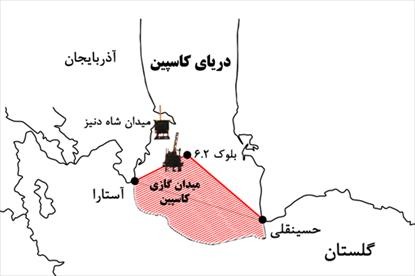
The 1954 and 1957 frontier agreements between Iran and Russia confirmed the two coastal endpoints between the countries—the Soviet border towns of Astara in the west and Hosseingholi (Esenguly) in the east. The pacts and the countries’ subsequent practice arguably consolidated the Astara-Hosseingholi line as a de facto boundary between their maritime areas of jurisdiction, leaving approximately 12 to 14 percent of the Caspian on the Iranian side. Nevertheless, the agreements did not expressly establish a maritime boundary or assign Iran a specific percentage of the Caspian, and their legal application to control of the sea has never been openly tested.
Debate over Iran’s share of the Caspian revived in Iranian political and academic circles in 1992. Iran’s negotiating team initially argued that the Caspian should remain jointly owned by the littoral states rather than divided. After the other countries rejected that position, beginning in December 1998 Iran consistently demanded an equal 20 percent share for each of the five littoral states. Heshmatollah Falahatpisheh, former chairman of parliament’s National Security and Foreign Policy Commission, has said the demand for a one-fifth share was based on a decision by Iran’s Supreme National Security Council. The 20 percent proposal was also rejected by the other four parties.
Whether and how to divide the Caspian according to the length and configuration of each country’s coastline has been one of the principal sources of dispute among the littoral states, particularly for Iran, whose southern Caspian coast is concave. A straightforward application of the median-line principle could therefore place Iran at a geographic disadvantage.
Iran wants the shape of its concave coastline to be treated as a “special geographic circumstance” when the methodology for establishing baselines is determined. Some experts have proposed repurposing the old line between Astara (now in Azerbaijan) and Hosseingholi (now in Turkmenistan) as a baseline from which to draw more favorable median lines in determining Iran’s 15 nautical miles of territorial water.
Clashing interests
In an interview with Entekhab News Agency published on August 22, former Iranian diplomat to the United Nations and international-relations expert Kourosh Ahmadi described the convention as merely a framework for bilateral and multilateral cooperation around the Caspian, without addressing the details of the disputes among the littoral states.
Ahmadi explained that if Azerbaijan and Turkmenistan accepted a straight baseline running from Astara to Hosseingholi, Iran could obtain something close to the share approved by the Supreme National Security Council. Under the convention, this is an issue that Iran must resolve with its two neighbors.
Article 1 of the convention, without naming Iran specifically, states that where the configuration of a coastal state’s shoreline “places that state at a clear disadvantage in determining its internal waters,” that circumstance should be taken into account in establishing the relevant methodology so as to achieve agreement among all parties.
Ahmadi says this provision was inserted into the convention at Iran’s insistence and that a similar point appears in an interpretive statement issued by then foreign minister Javad Zarif concerning Iran’s unfavorable coastal configuration.
Heshmatollah Falahatpisheh has also argued that the current faceoff with the US make this an inappropriate moment to bring the pact before parliament and that, in any event, it offers Iran no benefit while it “will render ineffective the two treaties signed between Iran and the Soviet Union in 1921 and 1940.”
That claim is seemingly belied by Article 20 of the convention, which preserves rights and obligations arising from other treaties. Nevertheless, in areas where the new five-party regime replaces the previous bilateral arrangements, it would become more difficult in practice for Iran to rely on interpretations such as exclusive Iranian-Soviet administration of the Caspian or bilateral joint ownership.
Some critics argue that the Islamic Republic has failed to defend Iran’s rights in the Caspian and that acceptance of the convention would constitute a betrayal of the Iranian people’s rights. According to Falahatpisheh, Russia, Azerbaijan, Kazakhstan, and Turkmenistan have divided the Caspian among themselves via side agreements without taking Iran’s interests into account, and if Iran’s parliament ratifies the convention, it will effectively be accepting that division.
It is still impossible to state definitively what percentage of the Caspian belongs to each state. But if the seabed were divided according to a “modified median line,” as the other four littoral states have agreed among themselves through a series of bilateral negotiations, Kazakhstan would secure approximately 27–30 percent, Turkmenistan 19–23 percent, Azerbaijan 18–21 percent, Russia 16–19 percent, and Iran 11–14 percent.
Kourosh Ahmadi rejects treating these figures as conclusive. He says that until Iran resolves its disputes with Azerbaijan and Turkmenistan over the seabed and subsoil and the parties agree on the method of delimitation, the share belonging to each country cannot be settled. At the same time, he notes that Iran has the shortest coastline on the Caspian. If the other parties accept Iran’s proposed straight baseline, however, Iran’s share could approach the 20 percent it seeks.
A circumscribed convention
While the other four Caspian states have formally ratified the convention, it has not entered into force for Iran. Rouhani’s presidential signature, however, is not entirely without legal consequence. Under Article 18 of the Vienna Convention on the Law of Treaties—widely understood as reflecting customary international law—a signatory state is obliged to refrain from acts that would defeat the object and purpose of a treaty, unless and until it makes clear that it does not intend to become a party. This does not require Iran to implement all provisions of the 2018 convention before ratification, but does prohibit it from taking steps that would fundamentally undermine the agreement.
In assessing the present wisdom of ratifying the Caspian Convention, it is worth taking a holistic view of what it does—and what it doesn’t do. The pact, while it contains clearly defined provisions, leaves multiple significant issues unresolved:
| Clearly Defined | Unresolved |
| 15 nautical miles of territorial waters | Iran’s percentage share |
| 10 nautical miles of exclusive fishing zone | Iran’s final baseline |
| Ban on military forces of non-littoral states | Iran-Azerbaijan seabed boundary |
| Navigation restricted to vessels flying littoral-state flags | Iran-Turkmenistan seabed boundary |
| Framework for environmental protection | Ownership of disputed fields |
Another economic and geopolitical consequence of the convention concerns the construction of subsea pipelines. Under Article 14, the route of a pipeline is determined by agreement among the states whose seabed sectors it crosses; consent from all five Caspian states is not required.
This provision could facilitate construction of a gas pipeline between Turkmenistan and Azerbaijan, making it possible to transport Central Asian gas to Europe without passing through Iran or Russia. Iran would still be able to raise objections on environmental grounds, but the convention does not appear to grant any one of the five states a veto over such a project.
Heshmatollah Falahatpisheh opposes ratification before Iran’s share of the Caspian seabed and subsoil has been determined. He says:
“For now, this convention is Iran’s only source of leverage. If Iran accepts it before determining its share and resolving its disputes with Azerbaijan and Turkmenistan, it will no longer have bargaining power. Moreover, acceptance of the convention would render the two treaties between Iran and Russia ineffective.”
Falahatpisheh also observes that the convention lacks a binding dispute-resolution mechanism. He says Article 21 leaves dispute settlement to negotiation and consultation, while mutual consent of the parties is required to engage in arbitration or other legal mechanisms. Consequently, if Iran cannot reach agreement with Azerbaijan or Turkmenistan, it cannot unilaterally refer the dispute to binding arbitration.
He further argues that once the convention has been ratified and registered with the United Nations, the other four countries, acting in coordination, might even be able to take Iran before the International Court of Justice in The Hague. Whether they could in fact do so without Iran’s consent remains a matter of debate.
Kourosh Ahmadi broadly agrees that the government should first resolve its disputes with Azerbaijan and Turkmenistan before ratifying the convention, although he emphasizes that the convention establishes only the general framework of the Caspian legal regime and does not address the disputed details.
No ratification without delimitation?
Article 8, perhaps the provision most criticized by opponents of ratification, states:
“Delimitation of the seabed and subsoil of the Caspian Sea into sectors shall be effected by agreement between States with adjacent and opposite coasts, taking into account generally recognized principles and norms of international law, in order to enable those States to exercise their sovereign rights to exploit subsoil resources and conduct other legitimate economic activities related to the development of seabed and subsoil resources.”
Critics argue that once the convention is ratified and becomes binding, resolving Iran’s disagreements with its two northern neighbors, Azerbaijan and Turkmenistan, will not be easy. They therefore propose that the government withdraw the ratification bill or make approval contingent upon first resolving Iran’s rights in the Caspian.
Unlike Falahatpisheh, who argues that the convention offers Iran no benefits, Ahmadi believes that the provisions summarized above are valuable. Despite widespread criticism of President Masoud Pezeshkian’s government for submitting the ratification bill to parliament, the timing may reflect security considerations. The bill has been introduced amid growing concerns about Azerbaijan’s relations with the United States and Israel and during the run-up to a Caspian summit in Tehran—originally scheduled for August 12, now reslated for September 23.
Member of parliament Hassan Ghashghavi says:
“It is now the turn of the Islamic Republic of Iran and the city of Tehran to host the next summit of the presidents and leaders of the Caspian littoral states. It is certainly neither appropriate nor desirable for us to host this important international summit while the convention has still not been approved by our parliament.”
Ghashghavi’s argument for ratification focuses on the security guarantees created by the convention. He asserts:
“This document imposes extensive legal and security restrictions on the other littoral states, particularly with respect to the presence of foreign powers, and these are entirely in the interests of the Islamic Republic of Iran.”
These remarks refer directly to the convention’s provision that no littoral state may make its territory available to a foreign power for an attack against another Caspian state. In the context of the ongoing war, the perceived value of this proviso appears to have driven the timing of the government’s decision to submit the ratification bill, eight years after it was signed.
An examination of the Caspian Convention shows that it neither necessarily reduces Iran’s share to 13 percent nor affirms Tehran’s demand for 20 percent. Its worth lies in establishing common rules for security, navigation, fishing, and environmental cooperation. Its weakness is that it postpones the issue most sensitive to Iran, the baseline and delimitation of the southern Caspian seabed, to future accommodations.
The central question before parliament, therefore, is not simply whether to accept or reject the convention, but in what order the decisions should be made: Should Iran nail down the treaty’s security guarantees at the expense of its ultimate means of leverage in negotiations over its maritime boundary and baseline? Or should ratification be postponed until Iran has hammered out a satisfactory agreement on its baseline and its rights to the seabed?