
In an overlooked 2022 interview, former state media chief Mohammad Sarafraz provides rare insight into Iran’s enigmatic figurehead.
The people of Iran have almost no direct knowledge of Mojtaba Khamenei, the man the Islamic Republic has proclaimed as its third Supreme Leader. Iranians have never heard a meaningful speech from him, they know nothing of his political agenda, and they are not even certain he survived the February 28 bombing of the Tehran compound of Ali Khamenei, his father and predecessor.
Under his father’s broad shadow, Mojtaba, whose 57th birthday is on September 8, was widely understood to have wielded considerable power for years without ever holding an official position within the IRI’s sprawling regime. There are virtually no statements on the public record that spell out his intellectual, political, economic, cultural, or social views.
The remarkable absence of information about the Islamic Republic’s paramount figure gives new significance to one of the few firsthand accounts of Mojtaba: that given in 2022 by Mohammad Sarafraz, the former head of state broadcaster IRIB and a long-time player in the circle of power elites within which Mojtaba operated.
Most of what is known about the Supreme Leader has come not even from associates of his but from a yet greater remove. For example, former parliament speaker Mehdi Karroubi, a candidate for the presidency in 2005, described in an open letter to Ali Khamenei how his son had interfered in the election:
“Reports emerged that your respected son, Aqa Seyyed Mojtaba, was supporting one of the candidates. As these reports became more widespread, I became concerned that this might reflect Your Excellency’s position. But my past experiences and my knowledge of you reassured me that this was his [Mojtaba’s] personal view. Later, I heard that a prominent figure had told you, ‘Your Aghazadeh [son] is supporting so-and-so,’ and you replied, ‘He is an Aqa [sir, influential figure], not an Aghazadeh [son of privilege].’”
Such accounts, while hardly illuminating about Mojtaba the man, helped fuel the perception that he was his father’s hand-picked successor, to the point that in 2009, protesters began chanting the slogan, “Mojtaba, may you die before becoming Supreme Leader.”
Thus if Mojtaba Khamenei is wounded but alive—as US president Donald Trump claimed on August 26—then there is a major gap between the power he is in a position to exert as the Islamic Republic’s Supreme Leader and the public’s understanding of him. A few recent interviews, with people who are close to him, or claim to be, have been more propagandistic than informative in nature and done little to close that gap. Sarafraz’s 2022 account, by contrast, offers rare and valuable insights.
Sarafraz’s access to power and singular interview
Born around 1961, Mohammad Sarafraz grew up in a working-class neighborhood in southern Tehran. He was a regular at Dakhmeh, a local hosseiniyeh (Shia gathering place) that after the 1979 revolution became a hangout for “pressure groups,” pro-regime club-wielding enforcers used to intimidate ordinary citizens and silence dissent.
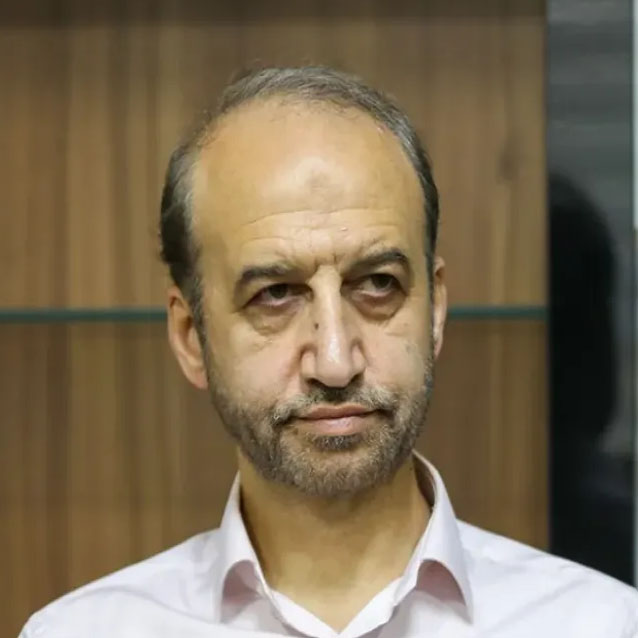
In 1992, after earning an MA and PhD in political science, he joined Islamic Republic of Iran Broadcasting (IRIB), where he became one of its longest-serving executives. He was chosen by Ali Khamenei to head the network between 2014 and 2016, after spending 22 years as director of its international broadcasting division, IRIB World Services. The division sought to burnish the Islamic Republic’s image through international TV programming and to expand the global network of support for the doctrine of velayat-e faqih (guardianship of the Islamic jurist), under which the Supreme Leader rules.
After stepping down as IRIB chief, Sarafraz was appointed by Ali Khamenei to the Supreme Council of Cyberspace, a position he still holds—despite having become a critic of the Islamic Republic and making statements in interviews that would seem difficult for the regime to tolerate.
In a lengthy 2022 interview, Sarafraz speaks of his close professional relationship with Mojtaba Khamenei over many years. The interview was conducted in Oman by Shahrzad Mirqoli-Khan, an Iranian émigré who had previously worked under Sarafraz, and posted to her YouTube channel.
Mirqoli-Khan, then married to an IRGC intelligence officer, was imprisoned from 2007 to 2012 in the United States after being convicted of forgery and abetting the sale of military materials to Iran. She is believed to have been swapped for an American hiker, Sarah Shourd, detained in Iran in 2009. Upon Mirqoli-Khan’s return to Iran, she was appointed director of the International Relations Department of IRIB subsidiary Press TV. After Sarafraz became head of the network, he appointed her its “special inspector” as part of a broad anti-corruption campaign. In 2016 she left the Islamic Republic permanently for Oman.
Mirqoli-Khan explicitly states that her goal in conducting the interview is to take even the smallest of steps toward preventing Mojtaba Khamenei from becoming Supreme Leader. She describes having personally spoken with Mojtaba and asking him whether he supported Sarafraz’s anti-corruption agenda, to which Mojtaba replied, “Yes. He has been our friend for 20 years, and we will definitely support him.”
Much of the information Sarafraz shares was not publicly known before the interview, and no one at his level has before or since painted such a detailed picture of the figure who now wears the mantle of Supreme Leader. Sarafraz’s motivation for giving the interview remains unclear, and the security officials and others he mentions have never publicly commented on it.
A portrait of Mojtaba, unretouched
Sarafraz emphasizes that he has no familial relationship with Mojtaba Khamenei and says he first encountered him at one of a series of meetings in 1997 of nearly two dozen regime insiders held at the Beyt-e Rahbari compound, the Supreme Leader’s Office. The sessions were convened to decide how to deal with Mohammad Khatami and the 20 million Iranians who had voted him into office as the country’s chief executive. He says:
“After the 1997 presidential election, when Mr. Khatami became president, it was the first time that someone who was not the establishment’s preferred candidate had been elected president. At that time, it was proposed that meetings be held to decide how to deal with this new phenomenon: a president who had been elected with a large number of votes.”
He continues:
“From then on, extensive meetings were held. Various people from the IRGC and other institutions attended, and at those meetings it was proposed that I participate as well. Mr. Mojtaba Khamenei himself also attended some of these meetings. After the meetings, he would take a summary of the discussions and recommendations to the Leader and brief him, or relay points from the Leader to us.”
The meetings did not continue in this format indefinitely. Instead, they became more focused and, according to Sarafraz, more important. He claims that when Khatami’s presidency ended, the number of participants was reduced to five, including both him and Mojtaba. Describing the format of the new meetings, Sarafraz says:
“After Mr. Khatami’s presidency, these meetings continued in a different form. The number of participants was reduced, and the meetings were limited to around five people. This continued until I became head of IRIB. After that, circumstances changed and the lines of communication gradually broke down.”
According to Sarafraz, the new five-person group met almost every week. Aside from Sarafraz himself and Mojtaba Khamenei, the two other regular participants were Hossein Taeb, then commander of the Basij and IRGC Intelligence Organization chief, and Hossein Fadaei, a member of the Headquarters for Combating Economic Corruption and later head of the Inspection Division of the Supreme Leader’s Office. The identity of the fifth participant changed depending on the main topic of the meeting.
“The subjects discussed at these meetings were mainly the country’s political affairs. For example, parliamentary elections, presidential elections, assessing different [political] figures, deciding whom to support, who should or should not receive votes, and how the political environment should be managed.”
These remarks are consistent with Karroubi’s letter to Ali Khamenei, in which he protested Mojtaba Khamenei’s election interference.
Sarafraz adds, “Alongside these discussions, Mr. Taeb would also provide reports on security matters, including the situation of political groups, their activities, and how to deal with these matters. However, security details were generally not discussed directly in the meetings. Mr. Taeb would meet privately with Agha Mojtaba to convey certain matters, and they would coordinate with each other.”
From rejecting arbitration to unleashing the crackdown
Mohammad Sarafraz describes the decision to crack down on the nationwide protests after the June 2009 presidential election and the harsh approach to dealing with protesters as resulting from the five-person meetings at the Beyt:
“In 2009, I was head of IRIB’s international broadcasting division. From a media standpoint, we believed that the more spirited and competitive the election was, the better it would be both for the country and for Iran’s image abroad. That’s why we tried to give equal coverage to the campaigns of all four candidates. The main contenders were Mr. [Mahmoud] Ahmadinejad and Mr. [Mir Hossein] Mousavi. In Tehran, the majority of the votes went to Mr. Mousavi, but in many provinces, smaller cities, and rural areas, according to the results announced, Mr. Ahmadinejad had received more votes. This led to allegations of election fraud. Immediately after the results were announced, large numbers of people took to the streets in Tehran, and a massive demonstration took place. We covered that demonstration as well, even broadcasting it live using a mobile broadcasting unit. But later, the head of IRIB at the time and the security agencies prevented us from continuing this coverage and removed the vehicle and live-broadcasting equipment from the streets. After that, the protests continued, and events unfolded that more or less everyone knows about.
“When the disagreements deepened, I suggested, at those very meetings, establishing some kind of arbitration or mediation mechanism so that the issue could be resolved peacefully and those who believed their votes had been disregarded could pursue their demands through a reasonable process. This proposal was also presented to the Leader of the Islamic Republic, but he did not agree. That arbitration and mediation model was never implemented. Then came the Ashura events, the clashes, and the deaths of a number of people.”
Speaking of Taeb’s pivotal role in conveying and implementing security decisions, Sarafraz says:
“Mr. Taeb had a direct line of communication with Mr. Mojtaba Khamenei, and decisions that were made would then become actionable through him. As far as I remember, after the Ashura events, claims emerged that unidentified individuals had burned a Quran or insulted Ayatollah Khomeini’s image and other religious sanctities. I cannot say with certainty whether these claims were true, but in any case, they became a pretext for initiating the widespread crackdown on protesters.”
Detailing Taeb’s relationship with Mojtaba, Sarafraz describes their frequent meetings:
”Mr. Taeb always had stacks of reports with him: reports about the meetings of political groups, various individuals, and some concerning people’s private and personal lives. Of course, we did not see these reports and were not directly privy to their details. Mr. Taeb also had numerous, more extensive meetings with Mr. Mojtaba Khamenei, separate from the meetings we attended. Those reports were certainly very influential. Mr. Mojtaba himself was also very interested in reports of this kind: reports compiled through wiretapping, infiltration, and various methods of gathering intelligence on political and social groups and even specific individuals.
“I was not directly aware of the details of these reports, but we witnessed them being presented regularly. If there had been any opposition to them, naturally, they would have stopped presenting them, but that never happened. These reports were continuously delivered, cited, and even used in decision-making.”
A question of competence
Sarafraz describes Taeb’s modus operandi in internal power struggles, noting:
“Over the years, I witnessed that whenever they wanted to eliminate someone, they would label that person as an ‘infiltrator’ or a ‘spy,’ or even accuse them of being affiliated with ISIS and the like. First, they would make such serious accusations against people, and then they would deal with them accordingly. In my view, this approach was really not honorable.”
Sarafraz argues that the Islamic Republic’s security apparatus in fact became increasingly vulnerable to foreign penetration under Taeb’s stewardship:
“During the period when Mr. Taeb had near-total control over the IRGC Intelligence Organization, the country’s security situation and the problem of infiltration had, in real terms, become much worse. A clear example of this is the increase in Israel’s infiltration of the country. Key figures in the nuclear sector and emerging technologies, as well as influential figures in the Quds Force, were assassinated. Israel targeted various facilities, including the Natanz nuclear facility and centers related to drones. All of this shows that infiltration within the country’s security structures was extremely extensive. Classified nuclear documents were easily taken out of some of the country’s most important facilities without any of these incidents being detected. These are indications of deep security gaps and extensive infiltration within the country’s security structures.”
He adds, “By contrast, many people who were not compromised and innocent were labeled spies and infiltrators. In a way, this became a cover for genuine infiltration to take place in the country, allowing key figures in the security sector to become compromised by foreign powers and the enemy. These are issues whose consequences we are grappling with today.”
In his opinion, both Taeb and Mojtaba Khamenei must be held accountable for these failings as well as for the repeated mass killings over the past two decades of ordinary Iranians peacefully protesting against the regime.
Mirqoli-Khan asks Sarafraz about claims she had heard regarding Mojtaba Khamenei’s belief in fortune-telling and similar practices. Sarafraz confirms the stories:
“During the period when I was in contact with him, Mr. Mojtaba Khamenei would also sometimes meet with people of this kind [fortune-tellers and soothsayers]. This suggested that such people, who claimed to possess occult knowledge or the ability to predict the future, would offer certain insights, and that some decisions, at least at certain times, were influenced by their advice. As far as I observed, this was the case.”
Sarafraz, however, offers no specific examples of such meetings or decisions influenced by occultists’ advice, and the claims cannot be independently verified.
No evidence of leadership capacity
Sarafraz goes on to assess Mojtaba’s qualifications to lead the Islamic Republic:
“It appears that he had been preparing to succeed his father for many years. I took part in various meetings with him and other friends who were present at the time. He gradually became involved in the country’s security and political affairs, familiarized himself with these areas, and little by little moved into a decision-making role.”
Yet he sees a fundamental difference between father and son:
“Before becoming Supreme Leader, Mr. [Ali] Khamenei served as president. He held important positions in the country, served on the Supreme Council of the Cultural Revolution, and held various military and security positions. Ultimately, he became president, meaning he held the country’s most important executive office. People also knew him. They were familiar with his speeches, his positions, and his record.
“Mr. Mojtaba Khamenei is someone who appears to prefer operating behind the scenes. To this day, he has never addressed the public, taken a public stance, or explained his views to the public.
“By contrast, someone who is going to occupy the position of Supreme Leader of Iran is, in effect, the country’s most powerful official, because under the current constitution, the Supreme Leader has absolute authority as a jurist. In other words, in addition to the broad powers granted to him by the constitution, he can intervene in other affairs of the country, halt existing processes, or set a new course. The military and security forces are directly overseen by the Supreme Leader, and he also has the power to intervene and make decisions in other matters of state.
“Therefore, someone who is going to occupy such an important position should have previously held important responsibilities, so that there is a basis for determining whether he is capable of handling such a responsibility.”
In Sarafraz’s view, those who take on high-level responsibilities should first have demonstrable achievements in lower-level positions. Referring to the country’s complex domestic, international, cultural, political, social, and economic challenges, he says:
“Running a country like this is not easy, and whoever holds this position must have exceptional managerial abilities. He must be known to the public and have a successful executive track record. Mojtaba Khamenei meets none of these criteria. I have to say, no, he does not meet the requirements to lead the Islamic Republic.”
Repression and resignation—the dismal balance
Drawing on more than two decades of personal association, Sarafraz describes Mojtaba Khamenei’s views on major areas of governance, saying:
“Regarding the numerous social problems, including addiction, theft, informal settlements (shanty towns), divorce, suicide, and other social ills, at least for as long as I was in contact with him, there was no proper solution, not just from him but essentially from the ruling establishment as a whole. The unproductive meetings that were held never produced the desired result.
“In cultural, ideological, and religious issues, he believed only in banning things, imposing restrictions, and preventing access. For example, when the issue of the internet came up, or earlier when satellite [television] was an issue, he believed in banning it. He believed people should not have access to satellite [television], opposed the expansion of the internet, and believed the internet should be completely blocked. He tended to favor prohibitive and restrictive measures, even though experience has shown that these approaches do not work and that one cannot solve a problem simply by banning [things].
“In the economic sphere, I think neither he nor any government has a clear solution to the country’s problems or a proper understanding of economics. I never saw any clear or definite position from Agha Mojtaba on economic issues. In practice, what I witnessed both during my time at IRIB and in the years that followed was that he showed no serious concern about economic corruption, particularly large-scale corruption at the country’s highest levels.”
Sarafraz states that Mojtaba was aware of the systematic corruption in the country but never confronted it, adding:
“We saw numerous examples of corruption at IRIB. We uncovered and pursued various cases, but later, the very person who was in some way involved in those cases became head of IRIB.” Mirqoli-Khan names Abdulali Ali-Asgari, and Sarafraz confirms that is who he was talking about.
Sarafraz agrees with the interviewer’s assertion that Mojtaba supported corrupt currents within the Islamic Republic, saying:
“In the Yas Holding case, which we at IRIB also became involved in through the organization’s tenders, we gradually became aware of the extent of the corruption and the role that very important people played in it. But this case was never properly investigated. Only a small part of it was examined, merely because of pressure from public opinion. Even that was done confidentially and behind closed doors. Sentences were handed down, but later we heard that those convicted spent only a very short time in prison, and there was never any serious or genuine investigation.
“The same pattern was visible in many other economic corruption cases. Whenever a corruption case became prominent in the public eye, they would bring forward parts of the case in an incomplete or staged manner, and even then, not transparently or publicly. They would broadcast a few statements from a well-known judge, who in my view did not have a good record either, along with a few statements from other people. But in the end, it was never clear what became of those sentences or where the cases ultimately ended up.
“In many cases, they would present people who did not have a central role as the primary defendants, for example in cases involving gold coins or foreign currency. But it would later become clear that the corruption was continuing and that the real problem lay elsewhere.
“In my view, there has never been any real investigation at the highest levels into those who control major rent-seeking companies, banks, and the country’s main economic institutions. The main source of corruption, in my view, is the country’s banking system and major rent-seeking companies. Whether in the banks, the so-called revolutionary institutions, the Mostazafin Foundation, the IRGC, pension funds, or other major economic entities, none of them has ever been seriously and genuinely investigated.”
Wealth and concealment: the Mojtaba succession project
Emphasizing that Ali Khamenei never publicly endorsed Mojtaba, the second of his four sons, as his successor, Sarafraz says:
“If we accept that Mojtaba is Ali Khamenei’s choice in the succession issue, there are two likely factors [at play]. The first is wealth and financial resources. A large portion of the country’s wealth is controlled by the Supreme Leader, and over time, that control has only expanded. There are enormous financial resources held by the Execution of Imam Khomeini’s Order, the Mostazafin Foundation, Astan Quds Razavi, religious endowments, and numerous other entities, over which the Leader ultimately has authority.
“Naturally, an important question arises: Who will control this wealth in the future, and how will it be managed? In my view, this is one of the important motivators for maintaining this structure within the same circle.”
The second factor that might have driven Ali Khamenei to choose Mojtaba as his successor, he argues, is preventing the truth behind crimes committed during the father’s tenure from coming to light:
“Important events have taken place in the country over the past several years, but the truth about them has never been fully established. For example, in the events of 2009, the number of people killed and the reason for their deaths; or the [2020] downing of the Ukrainian passenger plane and the many questions surrounding it; and many other incidents. If, following a leadership change, things unfold in a way that allows these cases to be reinvestigated, naturally, many facts will come to light.
“As is common when governments change, every new president criticizes the performance of the previous government and explains its mistakes. Now imagine a similar situation arising with the leadership. In that case, many of the issues of the past could come under scrutiny. Therefore, one could analyze it this way: there is a desire to continue along the same path and maintain the same system of running the country, and the issue of succession to the leadership, although ostensibly carried out by the Assembly of Experts, would in practice remain within the same framework.”
Power out of bounds
One of the glaring attributes of the doctrine of velayat-e faqih is the possession of power without responsibility or accountability—the complete absence of what is known elsewhere as a system of checks and balances. Neither Ali Khamenei, as Supreme Leader, nor Mojtaba, who has held no official position, has ever been required to answer for their decisions and actions.
This is evident in Mojtaba’s selection as the Islamic Republic’s third Supreme Leader. An individual has taken the seat of sovereignty without presenting a political program, without undergoing any vetting process, and without the most basic information about his views being known to the public. His public appearance as Supreme Leader has been put off for so long that the question of whether he is alive has become a central topic in domestic and international circles.
Proof of life can only be inferred from circumstantial evidence such as the return of Hossein Taeb to one of the country’s most sensitive security positions, through his appointment as commander of the Basij, the militia at the heart of the Islamic Republic’s apparatus of internal repression, despite Ali Khamenei having previously removed him from the position.
Sarafraz’s account shows that Mojtaba was involved in a significant amount of behind-the-scenes decision-making. But influence within the office of one’s father is hardly proof of one’s ability to govern a country in crisis. It remains unclear what plan he has to pull the country out of its ongoing military crisis; what he will do about the economic crisis; how will he justify hereditary succession; how independent is he of the IRGC; and, ultimately, how he aims to rehabilitate the government’s shattered legitimacy and create a popular base for his rule.
What we have is the account of a former government official who once had access to Mojtaba Khamenei’s decision-making circle, of which he later became a critic. In the absence of speeches, a political program, an executive track record, or even conclusive evidence of the declared Supreme Leader’s presence at the helm of government, this account offers one of the few windows into his closed world.
What can be seen through that window is the face not of a tested leader, but of someone accustomed to making decisions and exercising power without having to offer any justifications or face the slightest accountability. It remains unclear whether such a man can step out from the shadows and effectively represent a regime deeply at odds with much of the society it governs.