
Despite a tightening economic vise, the Islamic Republic still lavishes precious funds on self-promotion.
For over two months, Iran’s streets and squares have routinely been occupied by members of the new jan-fada movement, ordinary citizens who have pledged themselves as the regime’s “devotees unto death.” Crowds of these ardent supporters of the Islamic Republic erect mokeb encampments, modeled after pilgrimage way stations, where they offer free tea and food while asserting ideological control over public space. Staging demonstrations of loyalty to the regime and parading through neighborhoods as they chant slogans, often PA amplified and meant to intimidate, such as “Heydar, Heydar” and “Commander, give the order—whatever you command, we will carry out,” these jan-fada groups do not mobilize spontaneously. They are the product of an entrenched financial architecture designed to manufacture and sustain political allegiance.
As the destructive effects of the 40-day war sink into the Iranian economy, effects that grow more severe each day due to the US blockade, the state has slashed spending in almost every sphere. Funding for many state-owned companies, such as those in the electricity and water sectors, has been almost completely eliminated. Yet money still flows unabated to a sector with an already outsized budget allocation—propaganda.
Iran’s latest budget—which was proposed to the Majles in early January and received parliamentary approval on February 17—suggests that the Islamic Republic continues to treat control over ideology not as an accessory to government, but as one of its core functions. According to the 2026–27 national budget (which follows the Persian calendar, extending from March 21, 2026, to March 20, 2027) at least 188 trillion tomans (approximately $1.43 billion USD) in official public spending is directed toward media institutions, religious organizations, ideological outreach, and security-linked cultural bodies. This amount alone is comparable to the combined budgets of the Ministries of Communications, Justice, Culture, and Cultural Heritage, and it omits entirely opaque funding streams underwritten by quasi-governmental “charitable” institutions, or bonyads, that are overseen by officials at the very heart of the regime.
This budget allocation breaks down roughly as follows:
- Media and content production (state broadcasting, news agencies): ~45%
- Religious and ideological institutions: ~20%
- Military-security ideological sectors: ~20%
- Educational and cultural-engineering bodies: ~10%
- International ideological outreach organizations: ~5%
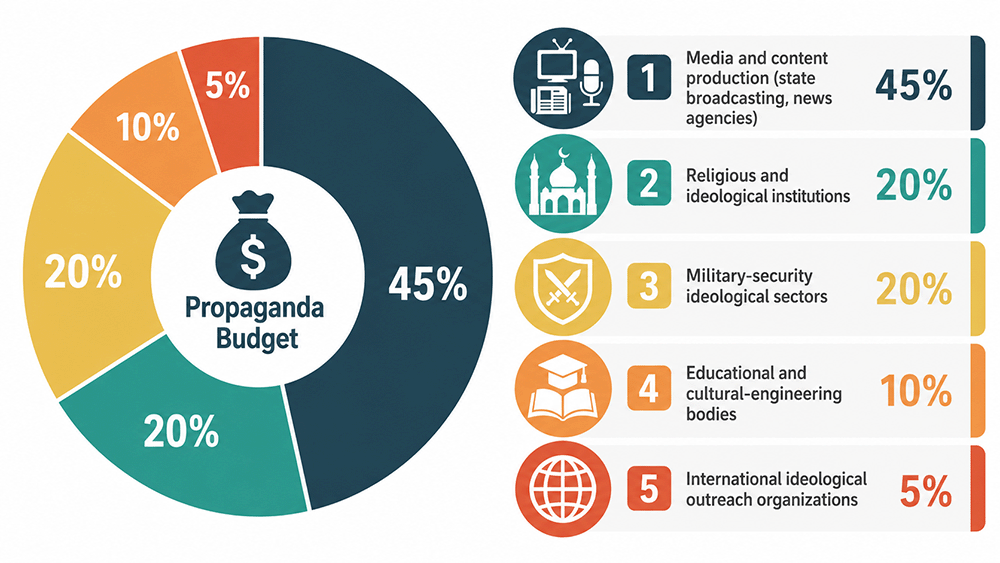
The use of these funds goes far beyond the production of media content. They support the recruitment and training of Iranians for careers of service to the regime, as well the organization and deployment of broad-based operations like the faux-grassroots, “astroturfed” jan-fada campaign and the coordination and promotion, both domestic and international, of political, religious, and military messaging.
The amount of spending on propaganda is notable not only for its volume, but for its durability. Even amid an unresolved war and a financially crushing blockade, there is no indication that disbursements in the propaganda realm have been curtailed. While the regime has made drastic cuts elsewhere, it has left belief-making largely untouched. Islamic Republic of Iran Broadcasting (IRIB), long one of the regime’s central ideological instruments, has even seen a marked increase in its already substantial allocation. Having received 29 trillion tomans under the 2025–26 national budget, IRIB’s allotment has ballooned to 80 trillion tomans in the current fiscal year.
Rather than flowing through a single ministry, propaganda funding is dispersed across a sprawling ecosystem of broadcasters, seminaries, cultural foundations, military organizations, and religious institutions. The largest share goes to state media and content production, including Iran’s broadcasting apparatus and affiliated press services, such as the Islamic Republic News Agency (506 billion tomans). A large portion also goes to numerous religious and ideological entities, ranging from the Islamic Development Organization (6.8 trillion tomans, up from 5 trillion last year) to the Imam Khomeini Educational and Research Institute (193 billion tomans for “discourse-building, explanation, and promotion of religious teachings”). Military-security cultural organs closely linked to the Islamic Revolution Guard Corps (IRGC) such as the Foundation for the Preservation of Sacred Defense and Resistance Values (724 billion tomans for “promotion of the Iranian-Islamic lifestyle“) take another sizable chunk.
Aside from domestic messaging, state budget funds also support international ideological outreach through IRIB’s Press TV subsidiary, institutions such as the Islamic Culture and Relations Organization (2.2 trillion tomans), and various bodies dedicated to exporting revolutionary ideology abroad, including Qom’s Al-Mustafa International University. The school has been sanctioned by the United States Treasury as “a recruiting ground for the IRGC-QF” (Quds Force, the Guards’ elite foreign arm). In the 2021–22 fiscal year, it received 487 billion tomans (about $115 million at the time), according to previous reporting by Tehran Bureau. Its allocation this year is almost 1.9 trillion tomans.
This extravagantly endowed structure reveals something deeper than the political importance of a censorship apparatus or messaging discipline. Propaganda functions as an economic sector, employing hundreds of thousands of Iranians, from journalists and filmmakers to clerics and educators. Some are ideologically committed. Many are financially dependent. Either way, the system reproduces itself through material incentives as much as political conviction.
Elite clans and ethereal audits
The propaganda industry is essential to the survival of the political business empires that effectively run the Islamic Republic. Connected through marriage and shared business interests, each of these elite clans fosters connections to high politics, state-funded media, and lucrative industries, placing friends and family members in central positions whenever possible. State-run media is an especially powerful tool. The clans own major news agencies like Tabnak (Mohsen Rezaei) and Fars News (Seyyed Nezalmodin Mousavi) and newspapers such as Hamshahri (Mohammad Baqer Ghalibaf), Khorasan (Mohammad Saeed Ahdian), and Iran (the Khameneis). They use these media outlets, which are mostly funded by taxpayers, to attack their political and business rivals and to dispel reports of corruption. Those with business activities in the media sphere often also run the institutions that control censorship boards and limit press freedom, empowering them to undermine and eliminate critics.
Behind many of these media ventures is the aforementioned Islamic Development Organization (IDO), a propaganda-focused umbrella charity that falls under the purview of the Office of the Supreme Leader (Beyt-e Rahbari). IDO is linked to a vast network of media organizations, including widely read news outlets such as Nasim Online and 90 Eqtesadi. Their ownership structures are intentionally complicated to hide the outlets’ affiliations with the IRGC, Tehran Bureau’s reporting has shown.
IDO’s finances are vetted by Mofid Rahbar, an auditing firm that exclusively services the companies that fall under the Beyt’s purview, along with the bonyads the Beyt also oversees, including EIKO, Astan-e Qods Razavi, and Bonyad Mostazafan (BM). The aegis of the Beyt-e Rahbari means these organizations—designed to enrich the IRGC and other regime insiders—are exempt from tax obligations, anti-corruption codes, and financial reporting rules.
The propaganda pyramid
As the main funding vehicle of the Islamic Republic’s propaganda machine, IDO sits at the top of a pyramid of subsidiaries that serve as cash cows for the ruling elite. Beneficiaries include the new (nominal) Supreme Leader, Mojtaba Khamenei, who played a major role at Beyt-e Rahbari long before his father’s death and whose family controls a network of influential media outlets, prominent book publishers, and media industry regulators.
Another clan leader with business ties to IDO is pasta tycoon Reza Motallebi-Kashani, who has common business interests with IDO trustee Seyyed Mehdi Khamoushi. An influential clerical ally of the late Ayatollah Ali Khamenei, Khamoushi has close ties to Ghalibaf and heads the board of trustees of Amir Kabir Publishing House (yet another Mofid Rahbar auditing client). Other former and current Amir Kabir trustees include the late Ali Larijani (former former secretary of the Supreme National Security Council), Mohsen Rafiqdoust (former IRGC minister and BM director), and Mohammad Saeedikia (former BM director and current head of the BM board of trustees).
IDO is one of the organizations instrumental in online censorship and facilitating internet shutdowns, Tehran Bureau’s reporting has shown. Its director—currently Hojatoleslam Mohammad Qomi—sits on the powerful Committee to Determine Instances of Criminal Content. This group, headed by Iran’s attorney general, Mohammad Movahedi-Azad, is in charge of monitoring internet content and blacklisting websites that are deemed inappropriate.
Aside from controlling internet censorship, IDO has overseen the launch of multiple e-propaganda operations, as well as a start-up that appears well-positioned to thrive in the increasingly repressive digital space that has emerged in Iran amid the current web blackout. In 2020, IDO founded a subsidiary, the Bina Institute, whose articles of incorporation describe its aim to produce “quantitative and qualitative analyses” on a broad range of issues, supported by creating “video clips [and] digital texts,” undertaking “social media activities,” and providing related “services to institutions and organizations.” In the Islamic Republic’s recondite language, this phrasing suggests that Bina was established, in part, to coordinate pro-regime social media accounts. Among its unambiguous remits is to “monitor and evaluate” the regime’s propaganda efforts.
A notable member of the Bina Institute’s founding board is Seyyed Meysam Seyyed Salehi, who manages Soroush, a domestic messaging app created to replace Telegram, which officials banned during the protests of 2017–18. As the crackdown on international social media usage intensifies, Soroush stands to benefit enormously. Between 2018 and 2020, Salehi was the CEO of Jam-e Jam Institute, which publishes Jam-e Jam newspaper and operates its website. Fariduddin Haddad Adel, brother-in-law to Mojtaba Khamenei, has long been a member of the institute’s board.
The intricate business connections between Iran’s power brokers and the country’s propaganda-producing organizations help explain why wartime stresses have not fundamentally altered their financial dispensations. The regime can tolerate runaway inflation and crippled industry. But weakening the propaganda apparatus would impact the networks that maintain ideological discipline, rationalize repression, and coordinate regional proxies.
The result is a system in which propaganda is treated less as a tool of persuasion than as infrastructure.
In most countries, propaganda is episodic, activated during elections or major crises. In Iran, it is a permanent, massive state expenditure. Even as its economy crumbles and prospects for a swift recovery dim, the Islamic Republic still maintains that controlling the narrative for a weary audience is worth hundreds of trillions of tomans. And perhaps the chants of the “devotees unto death” that resound within its ideological echo chamber are even loud enough to convince it.