“I Didn’t Learn Anything There”
An Iranian journalism school graduate speaks with Tehran Bureau.

An Iranian journalism school graduate speaks with Tehran Bureau.

Learning history one caricature at a time.

For those in the Iranian diaspora, 9/11 seemed to compound our pre-existing trauma and our desire to express it…in English. As this issue reflects, we’ve moved on, in various ways.

A photoessay on the boulevard that for more than two decades was the Downtown for the Iranian émigré community in Los Angeles.

Many Iranian officials who’ve studied in the United States have done anything but live up to the human rights–respecting reputation of a Western education.
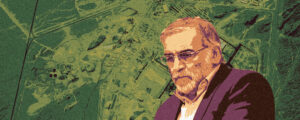
The supposed father of the feared “Iranian bomb” never published a scholarly work, but his family’s firms have done very well for themselves.
In this issue we turn to Paris, which has been a secular haven for generations of Iranians. Join us as we explore a few of Iranian culture’s many connections with the City of Light.
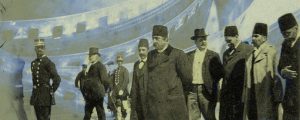
The French-Iranian Film Connection is almost as old as cinema itself. In 1900, in a French spa town and then the Paris world’s fair, Mozaffar al-Din Shah encountered the new medium and ordered it brought to Iran.
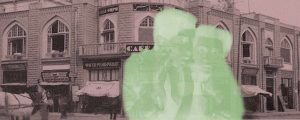
The first Iranian to set out to make a career as a filmmaker, Motazedi acquired his skills as a young man in Paris. He would go on to open Tehran’s first movie theaters accessible to both men and women.
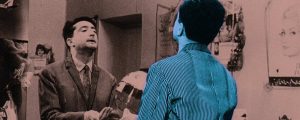
In the 1940s, Ghafari moved to Paris and into the heart of its vibrant cinephilic milieu, hired as an assistant by Henri Langlois, cofounder and director of the Cinémathèque Française.
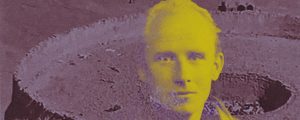
With his documentary The Lovers’ Wind, Lamorisse has a modestly scaled, marvelously achieved place in the French-Iranian Film Connection, and a tragic one.
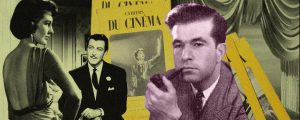
Hoveyda was at the center of Paris film culture in the 1950s and 1960s, writing pivotal essays for Cahiers du Cinéma alongside François Truffaut and spearheading acclaim for Jerry Lewis.
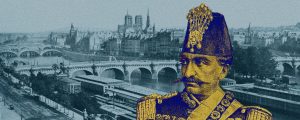
“We rose early in the morning, went down into a boat, and pushed off for the shore,” wrote Naser al-Din Shah, recalling his arrival in Paris on July 6, 1873.
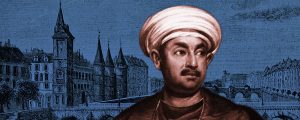
The travelogue of Khan, a Persian writer from India, would inspire the Shah of Persia to embark on a years-long journey through Europe.
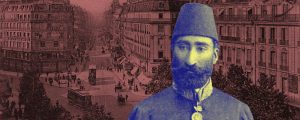
From the Diaries of Haj Sayyah: “There was music and singing in coffee shops and theatres…. The trees were festooned with green lights…. Young people and children danced…. They enjoyed complete freedom.”

Following in the tradition of capturing the American literary experience in Paris, from Stein to Hemingway to Baldwin, here’s a primer on some of the Iranian experience in France’s capital.

The individuals and organizations behind one of Iran’s most secretive business networks.
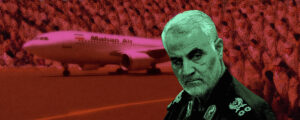
Qasem Soleimani’s legacy lies not in his military prowess, but in the business empire he helped create.

The financial institutions behind one of Iran’s most secretive business networks.

An industrialist’s vast business network illuminates how Iran’s political right is beholden to clerical and military elites.
Conflicts of interest, nepotism, and preferential treatment pervade charity ownership among Iran’s ruling elite.

How a wealthy, unelected right-winger pulls the strings of his coalition.
An airline executive with a long military record assumes an influential legislative post, expanding the Islamic Revolutionary Guard Corps’ political clout.
Parliament speaker Mohammad Qalibaf is filling top posts with friends and confederates such as Ahadian, an in-law of the supreme leader’s.

The Iranian pharmaceutical industry receives over $10 billion in government subsidies annually. It’s also so corrupt and inept that patients sometimes pay with their lives.
The Dastgheib family is mired in controversy surrounding the destruction of cultural heritage sites and the bullying of a seminary whistleblower who raised the issue.
A prominent newspaper editor related to Ali Khamenei benefited from the forced takeover of reformist media by courts close to the Supreme Leader’s Office.
Scrutiny of the outspoken Tehran MP’s family ties and business holdings shows him to be in collusion with the very individuals he publicly criticizes.
A reformist MP’s illustrious political career is studded with prestigious appointments, awards of merit, and one-on-one meetings with regime elites like the late General Qasem Soleimani.